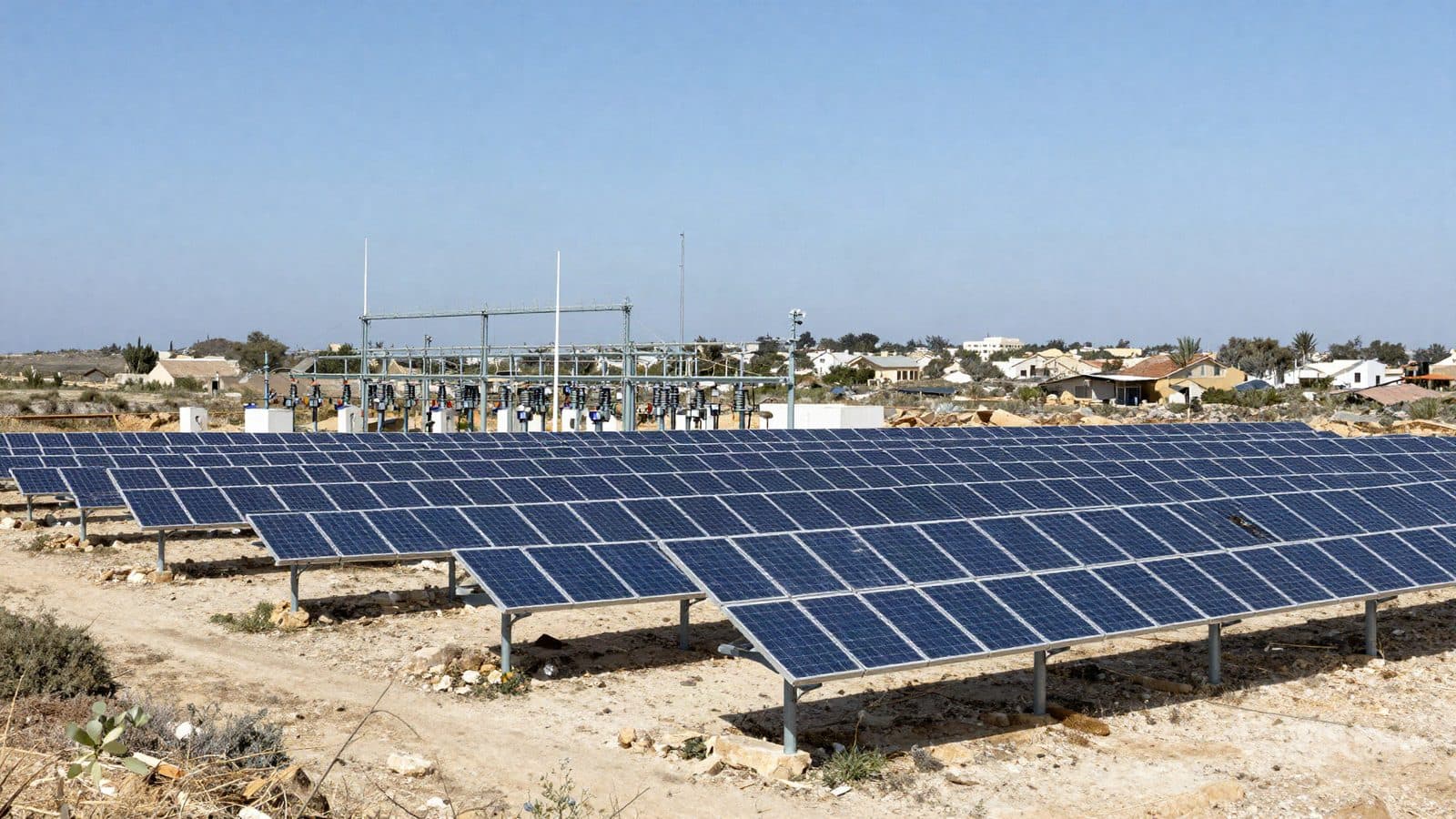
The Scale of the Problem
Cyprus curtailed 306 GWh of solar energy in 2025 — an 83% increase over 2024's already-alarming 167 GWh. At the average market price of €190/MWh, that represents over €58 million in energy value that was generated, measured, and then deliberately discarded because the grid couldn't absorb it.
This isn't a rounding error. It's a systemic failure that scales with every new MW of solar added to an isolated island grid with zero interconnection. And it's getting worse every year.
Curtailment Growth: 0 GWh to 306 GWh in 4 Years
System-wide curtailed solar energy across Cyprus
Source: TSOC operational data, Lighthief portfolio analysis
What does this mean for a typical 5MW park?
At 47% curtailment, a 5MW park with ~10,000 MWh annual gross production loses approximately 4,700 MWh to curtailment — worth roughly €893,000 per year in unrealised revenue. Over a 25-year project lifetime, that's over €22 million in permanently lost income.
Strategy 1: BESS Time-Shifting (Primary)
The most proven and immediately deployable strategy for recovering curtailed revenue is Battery Energy Storage Systems (BESS). The concept is straightforward: instead of wasting curtailed energy, store it in batteries and discharge during the evening peak when prices are highest.
This is not a future technology — it is operational today. Lighthief is preparing BESS deployment across multiple parks across Cyprus under Category B licensing, with first installations planned for 2026.
How BESS Time-Shifting Works
Charge during curtailment, discharge during evening peak
10:00 – 14:00
TSOC curtails your output. Instead of losing energy, the BESS charges from the curtailed solar production at €0 cost.
14:00 – 17:00
Battery holds stored energy. EMS monitors market prices and SOC levels, preparing for optimal discharge window.
17:00 – 21:00
Discharge at €212/MWh evening peak. After 86.32% round-trip efficiency, net revenue is ~€183/MWh.
BESS Revenue Model (5MW Park)
Why BESS Is the Primary Strategy
- Proven technology: LFP batteries with 15-year extended warranty, 7,000-cycle life at 70% SOH EOL
- Licensed today: Category B permits allow co-located BESS under existing PV licenses
- Bankable: Accepted by lenders with performance guarantees and insurance
- Scalable: Lighthief preparing BESS deployment across multiple parks with competitive pricing
- Fast payback: 4.0-year payback at current curtailment rates for 2-hour systems, 4.3 years for 4-hour
Strategy 2: Behind-the-Meter Consumption
A complementary approach is to consume curtailed energy directly on-site, avoiding the grid entirely. During curtailment periods, the TSOC is signalling that the grid doesn't want your energy — but that doesn't mean nobody can use it.
Behind-the-meter (BTM) consumption routes curtailed power to on-site loads that would otherwise draw from the grid, effectively converting wasted solar into direct electricity savings.
Typical On-Site Loads
- BESS auxiliary systems: Cooling, BMS, inverter standby — typically 30-50 kW per container
- Monitoring & SCADA: Site controllers, communication equipment, weather stations
- Security systems: CCTV, perimeter detection, lighting — 5-15 kW continuous
- Co-located industrial loads: Agricultural processing, cold storage, water pumping
Recovery Potential
Total BTM recovery: 350-1,300 MWh/year — modest compared to BESS time-shifting but essentially free savings with minimal capital expenditure.
Best for: Parks with adjacent commercial or industrial consumers who can absorb power during peak curtailment hours. Agricultural areas with irrigation pumps, cold storage facilities, or food processing plants are ideal candidates.
Strategy 3: Computational Load Monetisation
The most innovative approach is to convert curtailed energy into computation. When the grid refuses your electricity, use it to power computational workloads that create direct economic value — without needing grid export at all.
Two primary applications have emerged for solar parks with surplus curtailed energy:
Bitcoin Mining with Curtailed Solar
Converting waste energy into digital value
- • Zero electricity cost — curtailed energy is free
- • ASIC miners can start/stop within seconds based on curtailment signals
- • Revenue independent of grid pricing or electricity markets
- • Containerised solutions fit within existing PV park footprint
- • Proven model used by Riot Platforms, Marathon Digital in Texas
Read more: Solar Bitcoin Mining with Curtailed Energy
AI GPU Inference
Training and inference using free solar power
- • GPU clusters for AI inference workloads during curtailment windows
- • Revenue via cloud GPU rental platforms (€2-4/GPU-hour for H100s)
- • Batch processing workloads tolerate intermittent availability
- • Higher capital cost than mining but potentially higher margins
- • Growing demand from EU AI companies seeking low-cost compute
Read more: AI GPU Mining at Solar Farms
Cyprus Tax Advantage
Cyprus offers an IP box regime with ~3% effective tax on qualifying intellectual property income (80% deduction at 15% CIT) — one of the lowest effective rates in the EU. Computational workloads generating intellectual property (AI model training, data processing) may qualify for this preferential rate, significantly improving the post-tax return on curtailed energy monetisation.
Complexity vs Return Trade-off
| Factor | Bitcoin Mining | AI Inference |
|---|---|---|
| Capital cost | €200-400K per MW | €500K-1M per MW |
| Revenue certainty | Medium (BTC volatility) | Higher (contract-based) |
| Operational complexity | Low | Medium-High |
| Intermittency tolerance | Excellent | Good (batch workloads) |
| Cooling requirements | High (immersion or air) | Very high (liquid cooling) |
Combining Strategies for Maximum Recovery
These three strategies are not mutually exclusive. On a single 5MW site, they can be layered to capture progressively more of the curtailed energy waterfall. The key is prioritisation: highest-value recovery first, then cascading to lower-value but still profitable uses.
Combined Recovery Waterfall — 5MW Park Example
Annual curtailed energy: ~4,700 MWh (47% curtailment)
BESS Time-Shifting (Priority 1)
Captures ~2,350 MWh of curtailed energy, dispatches ~2,029 MWh at evening peak. Highest €/MWh value at ~€183/MWh net.
Behind-the-Meter Consumption (Priority 2)
Powers BESS auxiliaries, site loads, and co-located consumers with another ~300-500 MWh. Saves on grid import costs.
Computational Loads (Priority 3)
Remaining ~1,850 MWh of still-curtailed energy powers mining or AI inference. Variable return depending on BTC price or GPU rental rates.
The Urgency: Curtailment Is Getting Worse
If you think 47% curtailment is bad, the trajectory is even more alarming. Every year, more solar capacity connects to the same isolated grid, while storage deployment and interconnection lag far behind.
Curtailment Escalation: The Trend Line
200+ MW of new solar is in the pipeline for 2026-2027.
Without equivalent grid-scale storage deployment, curtailment will continue its exponential climb. The EuroAsia Interconnector won't arrive before 2029+. BESS is the only viable solution for the next 3-5 years — and every month of delay is revenue permanently lost.
The math is simple: at 55% curtailment, a 5MW park loses 5,500 MWh/year — over €1 million annually. Park operators who haven't deployed storage by then will be generating more energy that they waste than energy that they sell. That is not a sustainable business model.
Recover Your Curtailed Revenue
Every MWh curtailed is revenue lost forever. BESS can recover 50%+ of that value starting from day one of operation.
Whether you operate a 1MW commercial installation or a 10MW utility park, we can quantify your curtailment losses and design a recovery strategy tailored to your site.
Contact Alexander Papacosta: +357 99 164 158 | office@lighthief.com