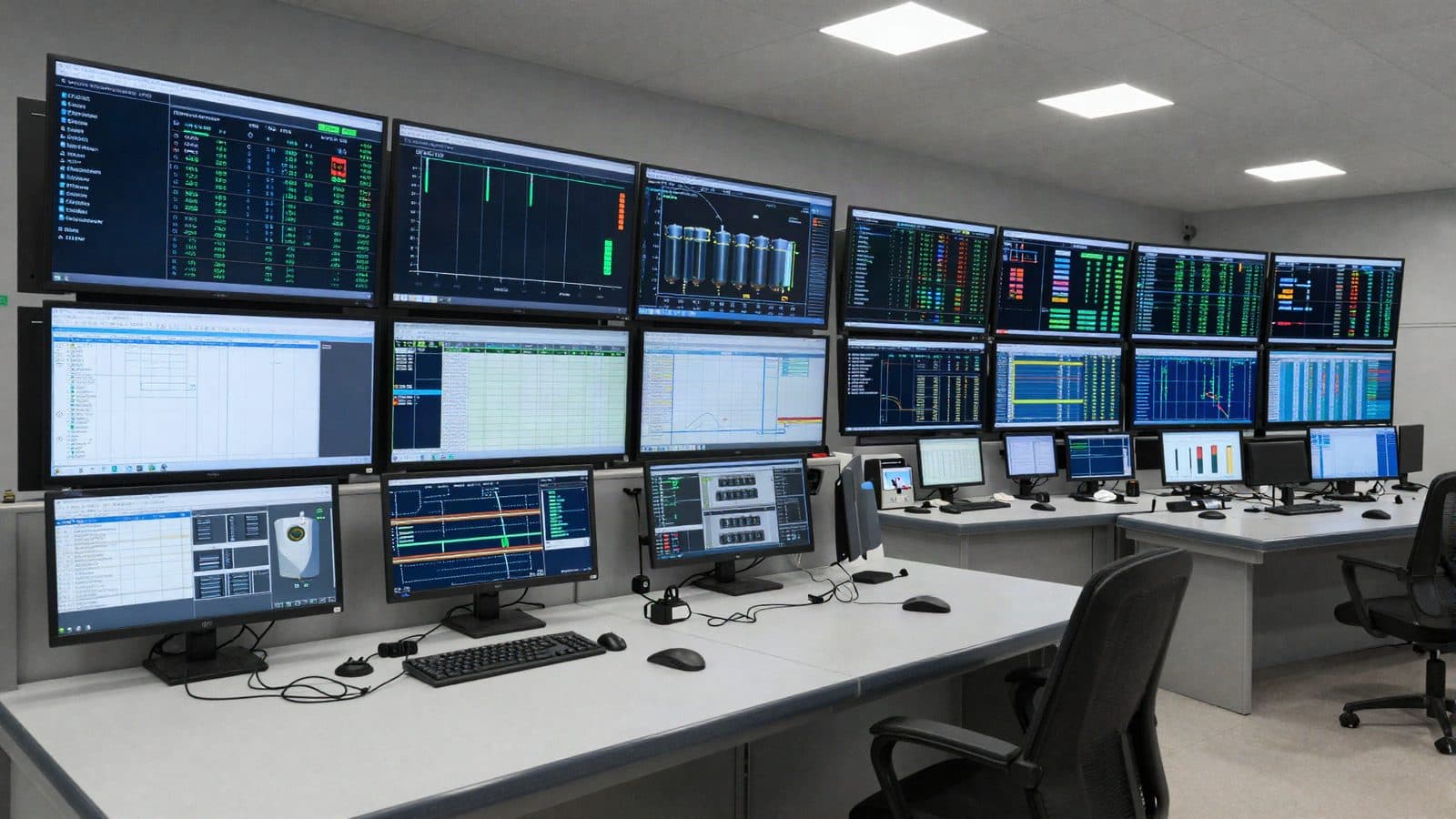
The Brain of Your BESS
A Battery Energy Storage System is only as smart as the software controlling it. The Energy Management System (EMS) sits at the centre of every operational decision your BESS makes: when to absorb curtailed solar, when to hold energy in reserve, when to dispatch to the grid, and how aggressively to cycle the cells.
Think of it this way: buying a BESS without a capable EMS is like buying a Formula 1 car and handing the keys to someone who learned to drive last week. The engine is identical, but the results will be dramatically different.
In the Cyprus market — where curtailment patterns shift daily, evening peak prices fluctuate between €140 and €220/MWh, and grid compliance rules are still evolving — the EMS is the single largest controllable variable in your BESS revenue equation. A well-configured EMS can generate 20–40% more revenue from the exact same hardware compared to a basic or poorly tuned system.
The revenue gap is real and measurable
For a 5MW/20MWh BESS system in Cyprus, the difference between a basic EMS running fixed schedules and an advanced EMS with real-time optimisation is approximately €60–80K per year in additional revenue — purely from smarter software decisions, with zero additional hardware cost.
What a BESS EMS Actually Does
A modern BESS EMS performs five core functions simultaneously, balancing revenue maximisation against battery longevity and grid compliance. Each function directly impacts your bottom line.
1. Curtailment Signal Integration
The EMS connects directly to the TSOC's curtailment dispatch system. When the grid operator sends a curtailment command — reducing your PV output from 100% to, say, 40% — the EMS automatically diverts the remaining 60% into the battery instead of wasting it.
2. SOC Optimisation
State of Charge management is where revenue is won or lost. The EMS must balance having enough capacity to absorb the next curtailment event against having enough stored energy to maximise evening discharge revenue.
- Predictive SOC targeting based on weather forecasts and historical curtailment patterns
- Dynamic adjustment throughout the day as actual production diverges from forecast
- Evening discharge scheduling optimised for peak price windows (17:00–21:00)
3. Degradation Management
Every charge-discharge cycle ages the battery. An aggressive EMS that squeezes maximum revenue today may destroy the battery by year 8 instead of year 15. A well-tuned EMS balances short-term revenue against long-term asset value.
4. Price Signal Response
When Day-Ahead Market (DAM) access legislation arrives — enabling BESS to charge from the grid, not just co-located solar — the EMS becomes a trading engine. It will buy electricity at midday lows (€105/MWh average, often near zero in spring) and sell at evening peaks (€212+/MWh), capturing the spread automatically.
5. Grid Compliance
Every BESS connected to the Cyprus grid must comply with EN 50549-2 grid code requirements. The EMS handles this automatically — managing frequency response, voltage regulation, ramp rate limits, and power factor correction without manual intervention.
- Automatic frequency droop response within 200ms
- Reactive power compensation for voltage support
- Anti-islanding protection and fault ride-through capability
Local SCADA vs Global SCADA
SCADA (Supervisory Control and Data Acquisition) is the monitoring and control layer that sits alongside the EMS. For multi-park portfolios like Lighthief's multi-park deployment, there are two distinct SCADA tiers — and both are essential.
Local SCADA
Per-park monitoring and control
- Individual battery rack monitoring (voltage, temperature, current per cell)
- Inverter performance tracking and fault detection
- Local fire suppression and HVAC integration
- Real-time SOC, SOH, and throughput dashboards
Global SCADA
Portfolio-level visibility and optimisation
- Aggregated data from all parks in a single dashboard
- Cross-park performance benchmarking and anomaly detection
- Fleet-wide firmware updates and configuration management
- Centralised alarm management and dispatch coordination
Why multi-park portfolios need both tiers
Local SCADA ensures each individual BESS operates safely and efficiently. Global SCADA enables portfolio-level insights that no single-park view can provide — identifying underperforming sites, optimising maintenance schedules across the fleet, and providing investors with consolidated performance reporting. For a portfolio like Lighthief's multi-park deployment, fleet-level visibility is not optional; it's essential for operational excellence.
Our EMS Choice: Voltus
After evaluating multiple EMS providers, Lighthief selected Voltus as the EMS and SCADA platform for our entire multi-park BESS portfolio. The decision was driven by five critical factors specific to the Cyprus market.
Native Curtailment Signal Integration
Voltus connects directly to TSOC's dispatch infrastructure, reading curtailment commands in real time and diverting energy to the battery within milliseconds — not minutes.
Proven on Island Grids
Voltus has operational experience on isolated island grids with characteristics similar to Cyprus — limited interconnection, high solar penetration, and volatile frequency dynamics.
LFP-Tuned Algorithms
SOC and degradation management algorithms specifically calibrated for LFP (Lithium Iron Phosphate) chemistry, targeting ≥70% SOH at year 15 with optimal cycling profiles.
Remote Monitoring & Updates
Cloud-based monitoring with remote firmware updates, configuration changes, and diagnostics. No truck rolls needed for software optimisation — critical when managing multiple distributed sites.
Multi-Revenue Stacking
When DAM arbitrage and ancillary services markets open in Cyprus, Voltus is pre-configured to layer multiple revenue streams — curtailment recovery, energy arbitrage, and frequency response — simultaneously.
EMS vs No EMS: The Revenue Difference
Same 5MW/20MWh BESS hardware. Same curtailment profile. Different software.
Without EMS
Manual operation, no automation
- • Manual charge/discharge by operator
- • Missed curtailment windows (minutes of delay)
- • Fixed discharge schedules, no price optimisation
- • No degradation management — battery ages faster
- • No remote monitoring or alerts
Basic EMS
Automated curtailment response, fixed schedules
- • Automated curtailment signal response
- • Fixed time-based discharge schedules
- • Basic SOC management with safety limits
- • Standard degradation protection
- • Basic remote monitoring dashboards
Advanced EMS
Real-time optimisation, predictive algorithms
- • Sub-second curtailment response
- • Predictive dispatch based on price forecasts
- • Dynamic SOC targeting with weather integration
- • AI-driven degradation optimisation
- • Multi-revenue stream stacking
The EMS Revenue Premium
Additional revenue from the same hardware, purely through smarter software. Over 15 years, that's €900K–1.2M in cumulative additional income.
The cost of operating without proper EMS. Over 15 years, manual operation leaves €1.8–2.4M on the table compared to an advanced EMS.
What to Look For in a BESS EMS
Whether you're evaluating EMS providers for a new project or considering an upgrade to an existing system, here is a practical buyer's checklist based on our experience planning deployment across multiple parks.
Must-Have Features
- Real-time curtailment integration: Sub-second response to TSO dispatch signals, not polling-based with minute-level delays
- Dynamic SOC management: Predictive algorithms that adjust targets based on weather, curtailment forecasts, and price signals
- Degradation-aware cycling: Battery health management that balances revenue against longevity, targeting contractual SOH guarantees
- EN 50549-2 compliance: Grid code conformance built into the control logic, not bolted on as an afterthought
- Remote management: Cloud-based monitoring, firmware updates, and configuration changes without site visits
Differentiating Features
- Multi-revenue stacking: Ability to layer curtailment recovery, energy arbitrage, and ancillary services simultaneously
- Weather-integrated forecasting: Solar production and curtailment predictions that improve SOC pre-positioning
- Portfolio-level optimisation: Global SCADA that benchmarks and coordinates across multiple parks
- API ecosystem: Open APIs for integration with third-party monitoring, trading platforms, and reporting tools
- Chemistry-specific tuning: Algorithms optimised for your specific cell chemistry (LFP, NMC) rather than generic profiles
Red Flags When Evaluating EMS Vendors
Fixed-schedule-only discharge — means the EMS cannot adapt to changing prices or curtailment patterns in real time
No remote update capability — every configuration change requires an on-site technician, costing time and money
Single-vendor lock-in — EMS that only works with one battery manufacturer limits your procurement options and negotiating leverage
No degradation modelling — cycling your battery without health-aware algorithms can void warranties and reduce asset life by 3–5 years
Bottom line: the EMS is not an optional add-on
Your EMS selection will determine 20–40% of your BESS project's lifetime revenue. It deserves the same due diligence as your battery procurement, your EPC selection, and your insurance coverage. A €50–80K investment in a premium EMS generates €900K–1.2M in additional revenue over the project lifetime. That's not a cost — it's the highest-ROI line item in your entire BESS budget.
Get the Right EMS for Your BESS Project
The difference between a good and great EMS is hundreds of thousands of euros over your project's lifetime. We can help you choose, configure, and optimise the right system.
Lighthief has selected Voltus EMS for our multi-park portfolio of planned battery storage. We bring procurement and design experience to every EMS discussion.
Contact Alexander Papacosta: +357 99 164 158 | office@lighthief.com