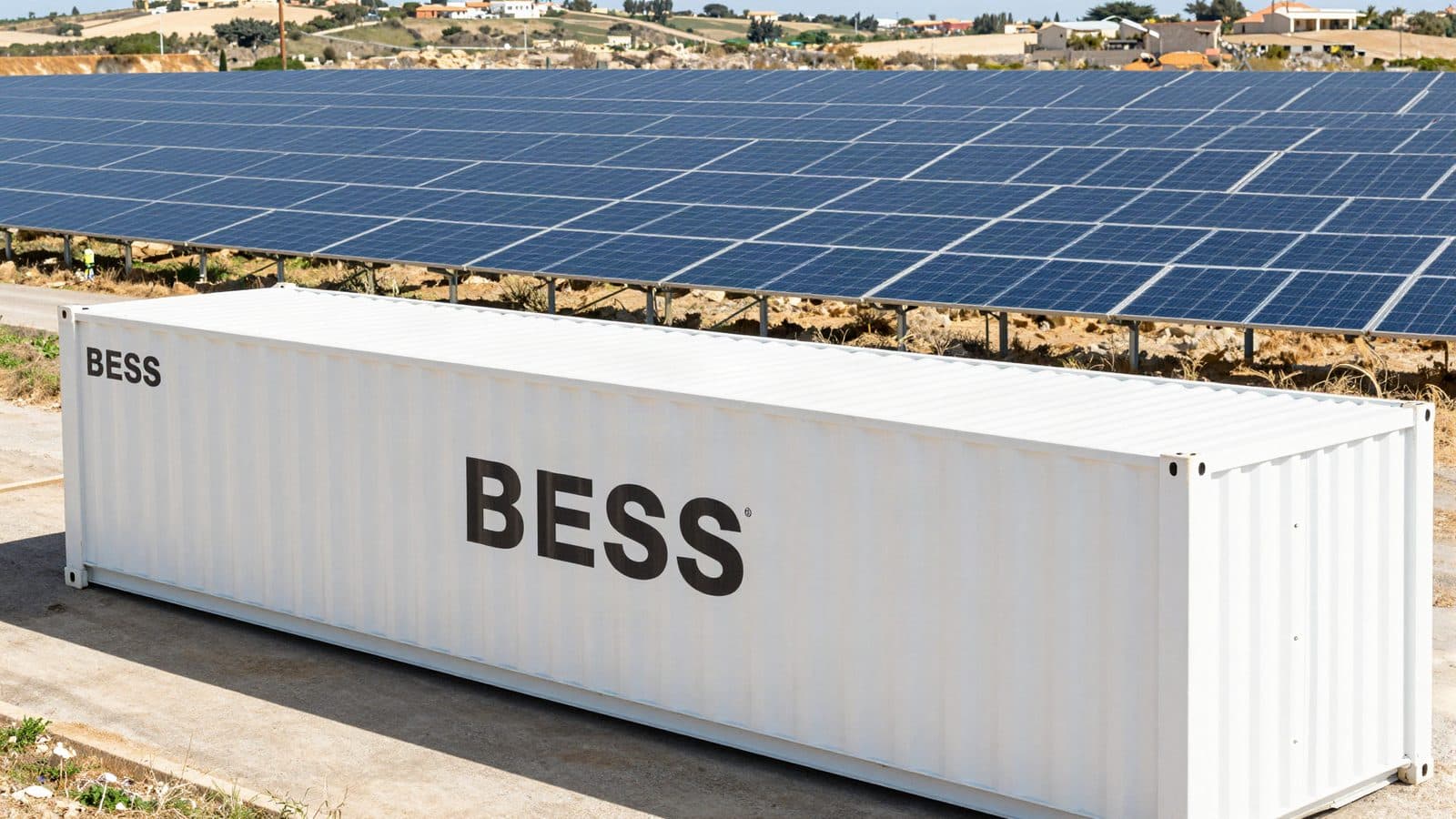
What BESS Actually Means for Your Solar Park
Forget the chemistry. Forget the spec sheets. What does adding a battery to your solar park actually change? The answer comes down to three fundamental shifts in how your asset operates and earns revenue.
From Price-Taker to Price-Maker
A solar-only park sells electricity when the sun shines — regardless of what the market is willing to pay. At midday in Cyprus, that means selling at €105/MWh on average when every other solar park is dumping power into the same grid. With BESS, you choose when to sell. Store at midday, discharge during the €212/MWh evening peak. You become a price-maker instead of a price-taker.
From Curtailed to Protected
Cyprus curtailment hit 47% in 2025. That means nearly half of your gross solar production is being ordered off the grid and wasted. With BESS, curtailed energy is captured and stored rather than lost. Instead of watching €178,600 per MW per year evaporate, you convert that wasted energy into evening revenue at €183/MWh net.
From Static Asset to Flexible Asset
A solar-only park does one thing: generate electricity when the sun is up. A PV+BESS park is a dispatchable power plant. It can provide grid services, participate in future ancillary markets, support frequency regulation, and respond to grid operator dispatch signals. That flexibility is where the next decade of revenue growth lives.
The bottom line: BESS doesn't change your solar panels. It changes your business model. You go from a passive generator subject to grid constraints and price cycles to an active market participant who controls when, how, and at what price your energy reaches the grid.
The Revenue Case: Numbers from Cyprus Parks
This isn't a theoretical exercise. Lighthief is currently deploying BESS across a large portfolio of solar parks in Cyprus — one of the largest distributed storage deployments in the Mediterranean region. The financial case is built on verified operational data from parks already running on the island.
At 47% curtailment, a typical solar park in Cyprus produces roughly 2,000 MWh per MW per year — but only sells about 1,060 MWh. The remaining ~940 MWh per MW is curtailed: ordered off the grid by the TSO and wasted. BESS recovers a significant portion of this curtailed energy and discharges it during the evening peak at €212/MWh. After accounting for 86.32% AC-AC round-trip efficiency, the net revenue per recovered MWh is approximately €183/MWh.
Revenue Impact by Park Size
Based on 47% curtailment, 50% BESS recovery rate, €183/MWh net discharge revenue (86.32% RTE)
1 MW Park
5 MW Park
10 MW Park
This is recovered revenue — money that would otherwise be lost entirely.
These figures represent energy that your park is already producing but being forced to throw away due to grid curtailment. BESS doesn't require you to generate more energy — it captures what you're already losing and sells it at the highest-priced hours of the day.
Beyond curtailment recovery, BESS also enables time-of-day arbitrage: shifting non-curtailed energy from the €105/MWh midday trough to the €212/MWh evening peak. Even on days with zero curtailment, BESS can capture the €108/MWh peak–midday spread — though grid charging for arbitrage is not yet legal in Cyprus.
How BESS Changes Your Grid Connection Value
Your grid connection isn't just a cable — it's a licensed right to inject power into the national grid. And on an isolated island like Cyprus, where grid capacity is finite and competition for dispatch windows is fierce, the quality of that connection matters as much as its existence.
A PV-only park's grid connection is essentially a one-way, daytime-only asset. It delivers power when the grid is already saturated with solar, contributing to the very oversupply that triggers curtailment. From the TSO's perspective, it's a source of instability — more supply when supply is already excessive.
PV-Only Grid Connection
Limited, inflexible, vulnerable
PV+BESS Grid Connection
Dispatchable, flexible, premium
The implications for PPA negotiations are significant. Off-takers — whether utilities, corporate buyers, or aggregators — increasingly prefer dispatchable supply. A PV+BESS park can offer a shaped PPA that guarantees delivery during high-demand hours, commanding a premium of €15–€30/MWh over flat solar PPAs. For a 5 MW park, that translates to €80,000–€160,000 in additional annual PPA revenue.
Looking ahead: As Cyprus develops its grid services market — following the trajectory of Germany, Italy, and the UK — BESS-equipped parks will be first in line for frequency response contracts, spinning reserve payments, and virtual power plant (VPP) participation. These revenue streams, worth €50–€120K/MW/year in mature EU markets, will be available exclusively to parks with storage. Your grid connection becomes the gateway to an entirely new category of income.
Asset Valuation: PV-Only vs PV+BESS
Beyond annual revenue, BESS fundamentally changes how banks, institutional investors, and secondary-market buyers value your solar asset. The shift is driven by three factors that directly affect how a discounted cash flow (DCF) model treats your park.
1. Protected Revenue Streams
A PV-only park's revenue projection carries a massive asterisk: curtailment risk. Every financial model must discount future cash flows by the expected curtailment rate — currently 47% and rising. When your model shows that nearly half of gross production generates zero revenue, the net present value (NPV) drops accordingly. A PV+BESS park eliminates much of this discount. BESS converts curtailed energy into revenue, stabilising the cash flow projection and reducing the risk premium that lenders and investors apply. The result: higher NPV, better debt service coverage ratios (DSCR), and more favourable financing terms.
2. Reduced Risk Profile
Institutional investors and infrastructure funds use risk-adjusted return metrics. A PV-only park in Cyprus now carries three compounding risks: rising curtailment, midday price collapse, and potential regulatory changes that could mandate storage retroactively. A PV+BESS park hedges against all three. BESS captures curtailed energy (curtailment hedge), sells at evening peak prices (price hedge), and pre-empts any storage mandate (regulatory hedge). Lower risk means a lower discount rate in DCF models, which directly increases asset valuation.
3. Future Revenue Optionality
BESS provides optionality that a PV-only asset simply cannot access. When Cyprus opens DAM arbitrage to BESS operators, when grid services markets launch, when VPP aggregation platforms arrive — only PV+BESS parks will participate. This optionality has quantifiable value. In mature EU markets, grid services alone generate €50–€120K/MW/year. Even before these markets open in Cyprus, sophisticated buyers factor in this optionality when valuing assets, because the battery hardware will already be in place to capture these revenues the moment regulation allows.
The Financing Advantage: PV-Only vs PV+BESS
PV-Only
PV+BESS
The valuation gap is widening. As curtailment increases and grid services markets develop, the premium that PV+BESS commands over PV-only will grow. Parks that add BESS now lock in current equipment prices while positioning for maximum future value. Parks that wait face rising curtailment losses and the risk of higher BESS costs as demand outstrips supply.
The Five Questions Every Park Owner Should Ask Before Adding BESS
Before committing to a BESS investment, every PV park owner should have clear answers to these five questions. They form the foundation of any credible BESS business case and will be scrutinised by lenders, investors, and independent engineers during due diligence.
What's my current curtailment rate?
This is the single most important input to your BESS revenue model. Request your actual curtailment data from the TSO or your monitoring system — don't rely on island-wide averages. Your specific location, grid connection capacity, and transformer station load all affect your actual curtailment rate.
What to look for: Monthly curtailment percentages for the past 12 months, seasonal variation, and trend direction. Parks on congested transformer stations may see curtailment significantly above the 47% island average.
What duration system matches my profile?
BESS systems come in different durations — typically 2-hour, 3-hour, or 4-hour configurations. The right choice depends on your curtailment profile and your view on future revenue streams. Larger batteries capture significantly more curtailed energy (87% for 4-hour vs 57% for 2-hour), but because CAPEX scales proportionally, all three achieve similar payback periods of 4–5 years.
Key trade-off: A 2-hour system (10 MWh for 5 MW) offers the fastest payback (~4.0 years) but captures only 57% of curtailment. A 4-hour system (20 MWh) captures 87% of curtailment, generates 53% more revenue, and pays back in ~4.3 years — with the lowest €/MWh installed cost and best future upside from DAM arbitrage.
What's the all-in installed cost per MWh?
Don't compare equipment prices alone. The all-in cost includes the battery containers, power conversion system (PCS), energy management system (EMS), grid connection upgrades, civil works, cabling, fire suppression, insurance during construction, and contingency. Ask for a fully loaded €/MWh figure that includes everything needed to reach commercial operation.
Benchmark: Volume procurement for 5 MW / 20 MWh systems (4-hour duration) typically delivers 15–20% savings versus individual procurement — all-in including grid connection, EMS, and 5% contingency.
What warranties and service agreements are included?
BESS is not a “set and forget” asset. It requires active monitoring, thermal management, firmware updates, and preventive maintenance. Your EPC partner should provide an OEM warranty with a clear State of Health (SOH) guarantee trajectory, a long-term O&M agreement with availability guarantees, and comprehensive insurance covering both construction and operational phases.
Minimum standards: 5-year base warranty (extendable to 15 years), ≥70% SOH guarantee at year 15, 97% annual availability SLA, 4-hour critical fault response, 24/7 remote monitoring, and UL 9540A safety certification.
What's my payback period under conservative assumptions?
Insist on seeing a financial model with conservative inputs — not best- case scenarios. Use verified curtailment data (not projections), current evening peak prices (not forecasts), and realistic degradation rates. A credible model should show payback under both the current 47% curtailment scenario and a more conservative 25–30% scenario.
What “good” looks like: For a 5 MW / 20 MWh system at competitive volume pricing, simple payback is ~8–9 years at 47% curtailment (conservative model). With 70% project finance at 4.5% interest, equity payback drops to ~6 years. When DAM arbitrage legislation passes, payback falls below 5 years.
Why Volume Procurement Matters
BESS equipment follows the same economics as any manufactured product: volume drives price. A single 5 MW park buying one battery container gets the retail price. Aggregating hundreds of MWh of demand from multiple parks gets a fundamentally different price from the manufacturer.
Volume procurement achieves 15–20% cost reduction compared to individual procurement. This isn't a negotiation tactic — it's the structural result of aggregating demand across multiple sites into a single OEM purchase order.
Volume Procurement: How Scale Drives Value
Where the Savings Come From
The maths is simple: volume procurement delivers 15–20% savings compared to individual procurement. For a 5 MW / 20 MWh system, that translates to significant CAPEX savings — enough to reduce payback by 1–2 years. Volume procurement doesn't just lower costs — it structurally improves the investment case.
Get Your Free BESS Assessment
Every PV park has a unique curtailment profile, grid connection, and revenue structure. We'll analyse your specific situation and show you exactly what BESS changes about your returns — using real data, not projections.
Whether you own a 1 MW commercial rooftop or a 10 MW utility-scale park, our team will model the BESS configuration that matches your investment objectives and payback targets.
Contact Alexander Papacosta: +357 99 164 158 | office@lighthief.com