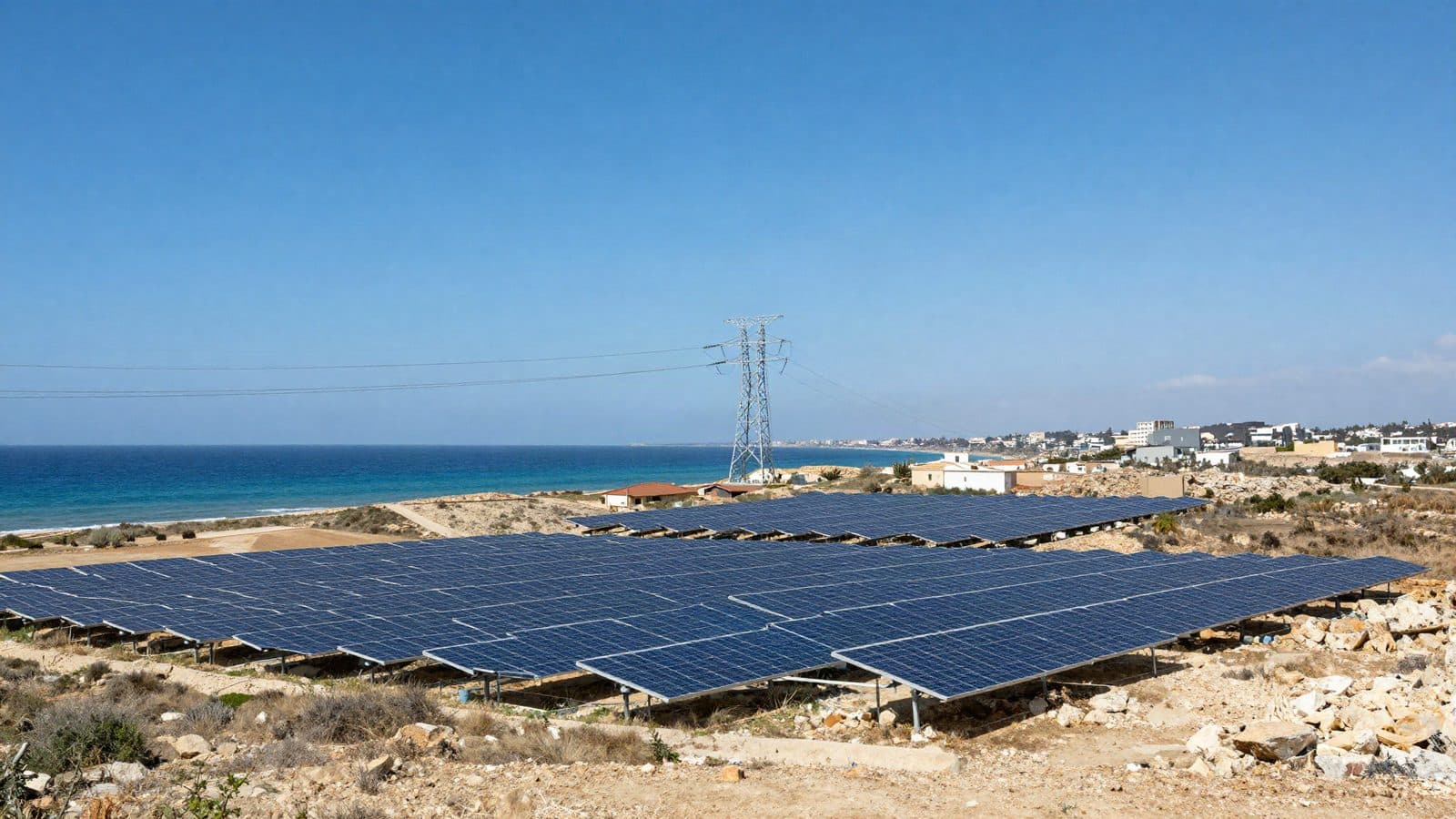
The Island Grid Problem
Cyprus's electricity grid has a peak demand of approximately 1,500 MW — and it is completely isolated. The Transmission System Operator Cyprus (TSOC) must balance supply and demand in real time with absolutely no help from neighbouring grids.
Consider what this means in practice. Germany can export surplus solar to 17 neighbouring grids. Spain sends excess power to France, Portugal, and Morocco. Even Greece — Cyprus's closest EU neighbour — has interconnectors to Italy, Bulgaria, and Turkey. Cyprus has none. Not a single cable connects the island to any other electricity system.
The EuroAsia Interconnector — an ambitious 2,000 MW submarine cable linking Cyprus to Greece and Israel — won't arrive before 2029 at the earliest. Until then, every electron generated on the island must find a home on the island, or it is wasted.
This isolation creates three cascading effects that fundamentally alter BESS economics:
- A curtailment spiral that worsens every year
- Extreme price volatility with no smoothing mechanism
- A must-run thermal constraint that locks out solar
Effect 1: The Curtailment Spiral
Without interconnection, excess solar production has literally nowhere to go. TSOC must maintain 210–250 MW of conventional thermal generation as “must-run” capacity at all times to provide frequency regulation and system inertia. This thermal floor is non-negotiable — the grid physically cannot operate without it.
On a sunny day with 500+ MW of solar producing, the grid literally cannot absorb all the energy. After meeting demand and maintaining the thermal floor, there is simply no room for the remaining solar output. The result: TSOC orders solar parks to curtail — to reduce or completely stop production despite perfect sunshine.
The trajectory has been devastating: from 0% curtailment in 2021 to 47% in 2025, a near-vertical climb that shows no sign of slowing. With 200+ MW of new solar capacity licensed for 2026–2027, the spiral will only tighten.
Curtailment Rate Comparison: Cyprus vs Mainland Europe
Island isolation drives curtailment rates 5–20× higher than interconnected markets
Source: National TSO data, ENTSO-E Transparency Platform (2024–2025)
The pattern is unmistakable: interconnection is the single greatest predictor of curtailment levels. Cyprus, with zero interconnection, sits at the extreme end of the scale — and will remain there until the EuroAsia Interconnector arrives in 2029 at the earliest.
Effect 2: Extreme Price Volatility
Island grids have exaggerated price swings compared to interconnected markets. On mainland Europe, interconnection acts as a natural price-smoothing mechanism — surplus electricity in one country flows to a deficit in another, dampening peaks and filling troughs.
Cyprus has no smoothing mechanism whatsoever. When solar floods the grid at midday, prices collapse toward €105/MWh (and often to €0) because there is no export route to relieve the oversupply. When the sun sets and thermal generation must ramp to meet evening demand, prices average €212/MWh because there is no imported electricity to moderate the surge.
The resulting average spread of €108/MWh between peak evening and midday prices is significantly higher than most mainland European markets — and this spread is the foundation of BESS arbitrage economics.
Solar oversupply crashes prices — no export route to absorb excess
Thermal generation needed after sunset — no imports to dampen prices
Price Spread Comparison: Island vs Mainland
Average peak-to-midday arbitrage spread by market
Wider spreads = more arbitrage revenue per BESS cycle
For BESS operators, this volatility is an opportunity, not a problem. Every charge-discharge cycle on Cyprus captures 2–3× more revenue than the same cycle on a mainland European grid, purely because the price spread is wider.
Effect 3: The Must-Run Thermal Constraint
Every electricity grid requires a minimum amount of synchronous generation running at all times. These thermal generators provide essential services that solar panels cannot: rotational inertia to resist frequency changes, reactive power for voltage control, and fast-acting governor response to sudden load swings.
On large continental grids, the collective inertia of thousands of generators across dozens of countries provides an enormous buffer. On Cyprus, the buffer is thin. TSOC requires 210–250 MW of conventional capacity online at all times — roughly 14–17% of peak demand — just to keep the grid stable.
This thermal floor directly competes with solar during peak production hours. On a day when demand might be 800 MW and solar is producing 500+ MW, the 250 MW thermal floor means only 550 MW of “space” exists for solar. The excess must be curtailed.
How BESS Breaks the Thermal Constraint
Without BESS (Current State)
- ×210–250 MW thermal must run at all times
- ×Thermal directly competes with solar for limited grid space
- ×No alternative source of inertia or frequency response
- ×Curtailment worsens every MW of new solar added
With BESS (Unlocked Potential)
- ✓BESS provides synthetic inertia via grid-forming inverters
- ✓Sub-second frequency response — faster than any thermal plant
- ✓Potentially reduces thermal must-run by 50–100 MW
- ✓Creates room for MORE solar — and more BESS revenue
This creates a virtuous cycle: BESS deployment reduces the thermal floor, which unlocks more solar capacity, which increases curtailment recovery opportunities for BESS, which improves BESS economics further. On island grids, BESS doesn't just benefit from the problem — it actively solves it while generating revenue.
Why This Makes BESS Economics Stronger
Every one of the three island-grid effects — curtailment, price volatility, and thermal constraints — individually strengthens the BESS business case. Together, they create economics that are fundamentally superior to mainland deployments.
This isn't theoretical. It's measurable, bankable, and available now. Let's compare the two environments side by side.
| Economic Factor | Island Grid (Cyprus) | Mainland Europe |
|---|---|---|
| Curtailment Recovery | 47% curtailed Massive pool of “free” energy | 2–10% curtailed Limited recovery opportunity |
| Arbitrage Spread | €108/MWh avg Midday €105 → Evening €212 | €20–40/MWh avg Interconnection smooths prices |
| Grid Services Value | Premium pricing Small grid = scarce service = high value | Competitive pricing Many providers = price compression |
| Competition Risk | Zero import competition No cheap electricity from neighbours | Import competition Cross-border flows cap local prices |
More “Free” Energy to Capture
At 47% curtailment, nearly half of all solar production is wasted. A BESS co-located with a 5 MW park can recover 2,000+ MWh annually — energy that costs nothing to capture because it would otherwise be lost entirely.
More Revenue Per Cycle
The €82/MWh spread means each charge-discharge cycle on Cyprus generates 2–3× more revenue than the same cycle on a German or Spanish grid. This dramatically shortens BESS payback periods.
Grid Services at a Premium
Frequency regulation on a 1,500 MW island grid is far more valuable than on a 500,000 MW continental grid. There are fewer providers, the service is more critical, and the TSO will pay accordingly.
No Import Competition
On mainland Europe, stored energy competes with cheap imports from neighbouring countries. On Cyprus, there are no imports — every MWh discharged from a BESS displaces expensive thermal generation at full evening prices.
The Convergence Window: 2026–2029
The next three to four years represent a unique convergence of factors that will likely never repeat. Three market forces are simultaneously aligned in favour of BESS deployment on Cyprus, and each has a limited time horizon.
(a) Peak Curtailment Revenues
Curtailment is at historic highs and climbing. BESS deployed now captures maximum curtailment recovery revenue — revenue that will naturally decrease once the EuroAsia Interconnector provides an export route for surplus solar. The first years of operation will generate the highest returns.
(b) Early-Mover Advantage in Ancillary Services
Cyprus's ancillary services market is nascent. The first BESS operators to offer frequency regulation, voltage support, and spinning reserve will secure premium contracts before competition drives prices down. As the market matures and more BESS comes online, these premium rates will compress.
(c) Historic Low Equipment Costs
LFP battery cell prices have fallen approximately 40% since 2023, driven by Chinese manufacturing scale and raw material price normalisation. Current all-in BESS costs of €110–136/MWh installed are unlikely to fall much further — and supply chain disruptions, tariffs, or demand surges could push prices back up.
What Happens After the Interconnector?
When the EuroAsia Interconnector eventually connects Cyprus to the European grid, curtailment will decrease — but BESS economics don't disappear. They evolve.
Curtailment recovery + time-of-day arbitrage
Reduced curtailment + growing grid services market
Cross-border arbitrage + ancillary services + capacity payments
Cyprus vs Other Island Grids: Lessons Learned
Cyprus is not the first island grid to face these challenges. Other isolated or semi-isolated systems have already proven that BESS is the solution — and the results consistently show that island grids are where storage economics are strongest.
United Kingdom
Before interconnector expansion
The UK deployed 4+ GW of BESS while still partially islanded from continental Europe. Early-mover BESS operators secured frequency response contracts worth £50–100k/MW/year — contracts that proved the commercial viability of grid-scale storage globally.
Ireland
Still partially islanded
Ireland's DS3 programme created a dedicated ancillary services market specifically because the island grid needed faster frequency response than thermal plants could provide. BESS operators earn €40–80k/MW/year from grid services alone.
Hawaii
Extreme solar + storage penetration
Hawaii mandated 100% renewable energy by 2045 and rapidly deployed BESS to manage extreme solar penetration on small island grids. The Kapolei Energy Storage project (185 MW/565 MWh) demonstrates utility-scale storage can replace thermal plants entirely.
Canary Islands
EU island grid with high solar
Each Canary Island operates an isolated grid similar to Cyprus. BESS deployments on Lanzarote and Tenerife have demonstrated 15–20% ROI on curtailment recovery alone, validating the island-grid BESS thesis in a Mediterranean/EU regulatory environment.
The pattern is universal: every island grid that has deployed BESS at scale has seen stronger returns than comparable mainland installations. Cyprus, with the EU's highest curtailment rate and widest price spreads, may represent the strongest island-grid BESS opportunity in Europe today.
Explore BESS Opportunities for Your Cyprus Park
Island-grid economics make Cyprus one of the strongest BESS markets in Europe. Whether you're building a new solar park or retrofitting an existing one, the numbers speak for themselves.
Our team has analysed curtailment data from dozens of operational parks across Cyprus. Let us show you what BESS can do for your specific project.
Contact Alexander Papacosta: +357 99 164 158 | office@lighthief.com