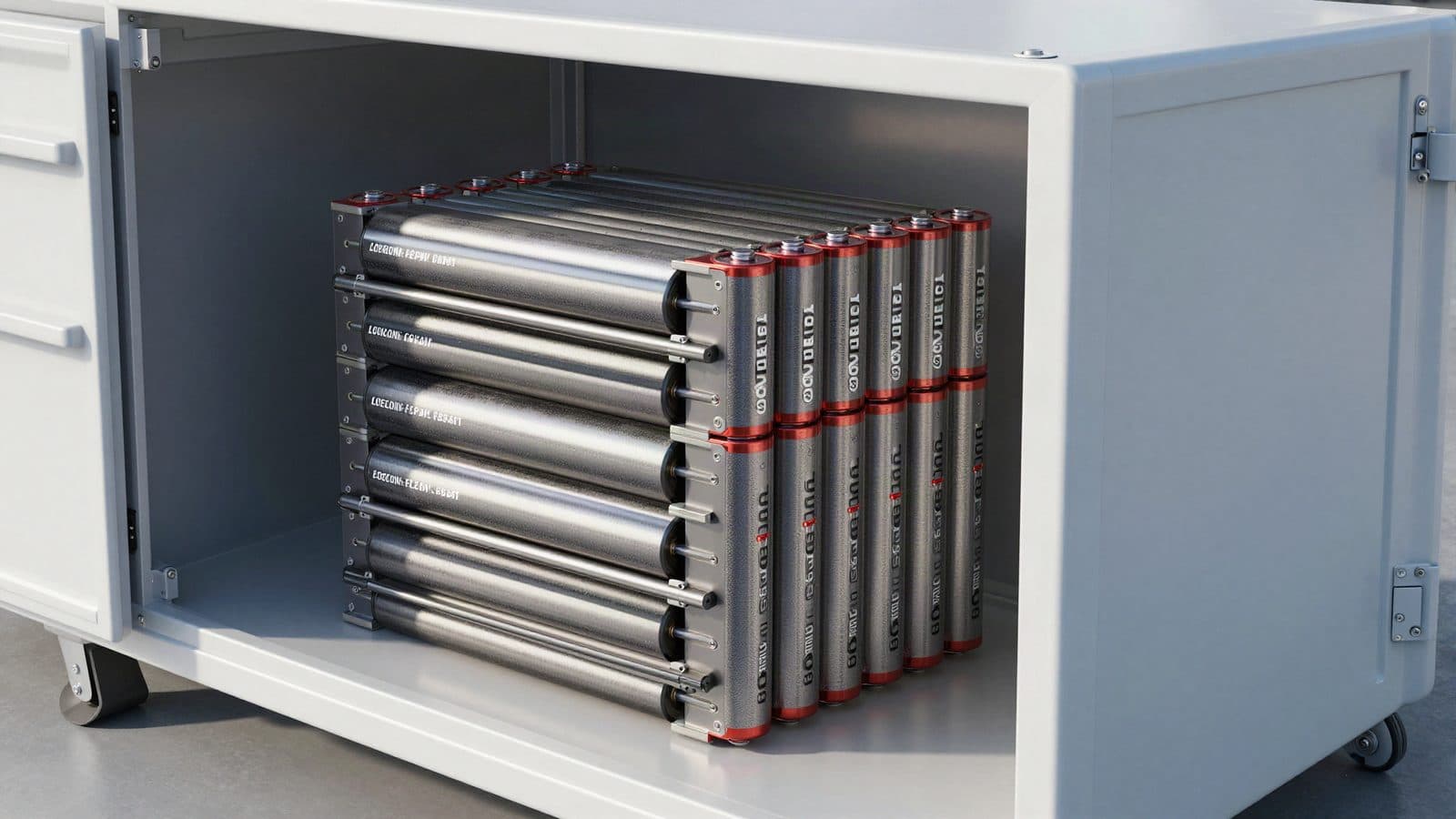
This Is Not a Chemistry Lesson
Both lithium iron phosphate (LFP/LiFePO4) and nickel manganese cobalt (NMC) are mature, commercially proven battery chemistries. Millions of cells of each type are deployed worldwide in electric vehicles, grid storage, and industrial applications. Neither is “new” or “experimental.”
But when you're signing an EPC contract that locks in a technology choice for 20 years — across dozens of parks, hundreds of containers, and tens of millions of euros — the differences between these chemistries stop being academic and start being financial.
This article isn't about cathode crystal structures or lithium-ion intercalation mechanisms. It's about total cost of ownership, insurance premiums, fire codes, warranty enforcement, and the bankability implications of picking the wrong chemistry for a utility-scale deployment in a Mediterranean climate.
The Head-to-Head Comparison
Before diving into the business case, here's a side-by-side view of the metrics that actually matter for utility-scale BESS. Pay attention to the columns that affect your 20-year financial model — not the ones that matter for an electric car.
| Metric | LFP (LiFePO4) | NMC | Utility Relevance |
|---|---|---|---|
| Cycle Life | 7,000+ cycles | 3,000–5,000 cycles | Critical |
| Cost per Cycle (Levelised) | Lower | 1.4–2.3× higher | Critical |
| Thermal Runaway Onset | >270°C | 150–210°C | Critical |
| Fire Risk | Inherently safer | Higher — requires active suppression | Critical |
| Energy Density | ~160 Wh/kg | ~200–250 Wh/kg | Low |
| Calendar Life | 15–20 years | 15–20 years | Moderate |
| Round-Trip Efficiency | 86–88% | 86–88% | Comparable |
| Degradation Curve | Linear, predictable | Steeper after year 5–8 | Critical |
The Key Takeaway
NMC's only advantage — higher energy density — is the one metric that doesn't matter for utility-scale outdoor deployments. You're not trying to fit a battery into a car chassis. You have land. What you need is longevity, safety, and predictable economics over two decades.
Cycle Life Economics: The 20-Year Math
This is where the LFP decision pays for itself — literally. The difference in cycle life between LFP and NMC isn't a minor specification detail. It's the difference between a battery that lasts the full investment horizon and one that needs a costly mid-life replacement.
LFP: 7,000+ Cycles
At 70% end-of-life threshold
NMC: 3,000–5,000 Cycles
At 70% end-of-life threshold
Our Warranty Data Tells the Story
The EVE LFP cells in our Linyang-integrated containers carry SOH performance guarantees that are only possible because of LFP's predictable, linear degradation profile:
These are contractual guarantees from the OEM, backed by warranty reserves on their books — not marketing estimates. NMC manufacturers rarely offer comparable guarantees beyond year 10 because the degradation curve becomes too unpredictable.
The Mid-Life Replacement Trap
NMC proponents often compare upfront €/kWh costs, where NMC can appear competitive. But this ignores the elephant in the room: if your NMC system hits end-of-life at year 10, you face a full re-celling or container replacement at a cost of 40–60% of your original CAPEX — at a point when your revenue model assumed the system was still earning. Factor in 2–4 months of downtime during replacement, lost revenue, re-commissioning costs, and updated permitting, and the total cost of ownership for NMC can exceed LFP by 30–50% over 20 years.
Fire Safety: A Non-Negotiable for Outdoor Cyprus Deployments
Cyprus summers routinely hit 45°C ambient temperatures. BESS containers sitting in direct sunlight on exposed land parcels adjacent to dry vegetation face thermal stress that would be manageable in Northern Europe but becomes a genuine safety consideration in the Eastern Mediterranean.
The difference between LFP and NMC in thermal stability isn't marginal — it's fundamental.
LFP Thermal Profile
NMC Thermal Profile
Real-World BESS Fire Incidents
The most high-profile BESS fires have predominantly involved NMC chemistry:
- Arizona, USA (2019): McMicken NMC BESS explosion injured four firefighters. Root cause: thermal runaway cascading through NMC modules with inadequate ventilation.
- South Korea (2017–2019): 23 BESS fire incidents, the vast majority involving NMC chemistry. This triggered a nationwide safety review, temporary moratorium, and revised safety standards that added significant cost to NMC deployments.
- Liverpool, UK (2020): NMC-based grid-scale BESS fire burned for days, requiring extensive emergency response and causing significant environmental contamination.
“In a hot Mediterranean climate where ambient temperatures regularly exceed 40°C, the 60–120°C margin between LFP's thermal runaway onset and peak summer conditions is not a luxury — it's a fundamental safety requirement. With NMC, that margin shrinks to as little as 105°C, and every degree matters when you're deploying battery storage across an island.”
— Alexander Papacosta, Managing Director, Lighthief Cyprus
Insurance Implications: LFP Makes Your Project Insurable
Insurance is where the LFP vs NMC debate moves from engineering preference to hard financial reality. Underwriters at the world's leading insurance firms have learned from the BESS fire incidents of the past decade, and their pricing reflects a clear chemistry preference.
LFP Insurance Advantages
NMC Insurance Challenges
What This Means for Project Finance
When lenders evaluate a BESS project, insurance availability and cost are key inputs to the financial model. A project that cannot secure comprehensive insurance at reasonable rates faces higher equity requirements, worse debt terms, and potentially fails to reach financial close altogether. By choosing LFP, we ensured that every park in our portfolio qualifies for full CAR/EAR coverage during construction and competitive property insurance rates during operations — making each project individually bankable.
Why NMC Still Dominates Headlines
It's worth being fair to NMC. It's not a bad chemistry — it's the wrong chemistry for this application.
NMC's higher energy density (200–250 Wh/kg vs LFP's ~160 Wh/kg) represents a genuine advantage in applications where weight and volume are critical constraints. This is why NMC dominates the electric vehicle market, where every kilogram matters for range and performance. It's also relevant for urban or rooftop installations where space is at a premium.
But for utility-scale outdoor BESS? The calculus is entirely different.
Land Is Not the Constraint
Utility BESS sites in Cyprus are co-located with solar farms on multi-hectare parcels. The 20–30% footprint savings from NMC's higher density are irrelevant when you have acres of available land.
Longevity Is the Constraint
A 20-year PPA or investment horizon demands a chemistry that can deliver 7,000+ cycles without mid-life replacement. That's LFP's domain, and NMC cannot match it.
Safety Is the Priority
Outdoor deployments in hot climates, adjacent to agricultural land and rural communities, demand the safest possible chemistry. LFP's inherent thermal stability is a requirement, not a preference.
The Market Agrees
Globally, LFP has overtaken NMC for stationary storage deployments. According to BloombergNEF, LFP accounted for over 85% of new utility-scale BESS installations worldwide in 2025. The market has spoken: for grid storage, LFP is the standard. NMC retains its position in EVs, but the utility storage sector has moved on.
Our Choice: EVE LFP Cells, Linyang Integration
We didn't just choose a chemistry — we chose the specific cell manufacturer and system integrator that provide the best bankability profile for our portfolio.
EVE Energy — Cell Manufacturer
EVE Energy is a global top-5 LFP cell manufacturer, supplying cells for both EV and stationary storage applications worldwide. Their LF280K cells, used throughout our portfolio, are among the most widely deployed utility-grade LFP cells globally.
Linyang — System Integrator
Linyang integrates EVE cells into fully containerised, TÜV-certified BESS units ready for utility-scale deployment. Each container is a complete, pre-tested energy storage system.
Portfolio at a Glance
Discuss Your BESS Chemistry Options
Whether you're evaluating LFP vs NMC for a new project or reviewing an existing proposal, our team can walk you through the 20-year financial implications of each chemistry choice — with real data from our deployed LFP systems.
Contact Alexander Papacosta: +357 99 164 158 | office@lighthief.com