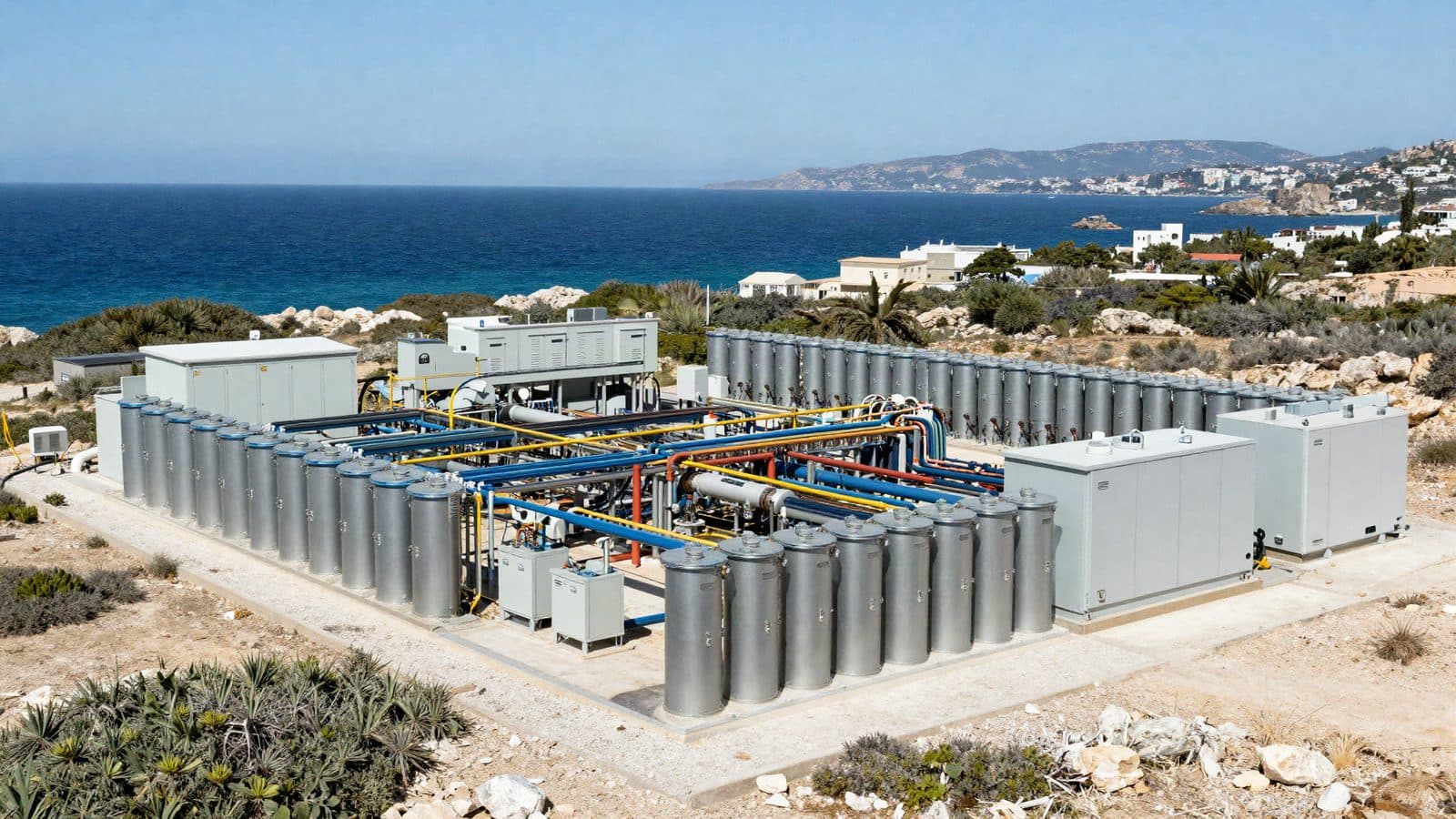
What Is a Virtual Power Plant?
A Virtual Power Plant (VPP) aggregates distributed energy resources — solar parks, battery energy storage systems, demand response assets — into a single controllable entity. To the grid operator, a VPP looks like one large, dispatchable power plant. In reality, it's dozens or hundreds of smaller assets coordinated in real time by sophisticated software.
Think of it as an orchestra: each instrument (solar park, battery, flexible load) plays its own part, but the conductor (the VPP platform) coordinates them into a single coherent performance. The grid operator sees one reliable, responsive power source — not a collection of intermittent renewables.
VPP Architecture
How distributed assets become a single power plant
Distributed Assets
BESS units, solar inverters, and flexible loads across multiple locations, each with local controllers and metering infrastructure.
Communication Layer
SCADA systems and real-time telemetry connect each asset to the central VPP platform, enabling sub-second monitoring and dispatch commands.
Aggregation Platform
The VPP software optimises dispatch across all assets, presents a single bid to the market, and settles revenue to individual asset owners.
Why island grids matter: On interconnected mainland grids, VPPs compete with large conventional plants and cross-border imports. On an isolated island grid like Cyprus's, VPPs are especially valuable because the grid has far fewer resources to call on — and every megawatt of flexible capacity is worth more.
Why Island Grids Need VPPs Most
Cyprus operates a 1,500 MW isolated electricity grid with zero interconnection to any neighbouring system. TSOC (the Transmission System Operator of Cyprus) must maintain 210–250 MW of thermal must-run generation at all times simply to keep the grid stable — even when renewable generation could cover the entire demand.
A VPP aggregating 100+ MW of BESS capacity could fundamentally change this equation. Batteries respond to frequency deviations in milliseconds — far faster than thermal plants that take minutes to ramp. A VPP of this scale could provide the stability services currently supplied by fossil fuel plants, potentially reducing the thermal must-run requirement and unlocking more room for renewables.
What a 100+ MW BESS VPP Provides to Cyprus's Grid
- Frequency response: Sub-second reaction to grid frequency deviations — 100x faster than conventional thermal plants
- Synthetic inertia: Mimics the stabilising effect of large rotating generators, replacing the physical inertia that renewables lack
- Voltage support: Active and reactive power management to maintain grid voltage within safe operating ranges
- Peak demand reduction: Discharge aggregated capacity during system peaks to prevent load shedding and blackouts
- Reduced must-run: Potentially lower the 210–250 MW thermal floor, freeing capacity for renewables and reducing system costs
- Black start capability: In extreme scenarios, BESS can help restore grid power after a complete outage — critical for island grids
VPP Revenue Streams for BESS Operators
VPP participation unlocks five distinct revenue streams that are unavailable to standalone BESS operators. Each stream compensates BESS for a different grid service, and they can be stacked — a single battery system earning from multiple services simultaneously.
a) Frequency Containment Reserve (FCR)
FCR requires response to frequency deviations within seconds. When grid frequency drops below 50 Hz (indicating a supply shortfall), the VPP dispatches stored energy. When frequency rises above 50 Hz (indicating oversupply), batteries absorb excess. BESS is uniquely suited to this service because its response time is measured in milliseconds, compared to minutes for thermal plants. In mature EU markets such as Germany and the Netherlands, FCR revenues range from €30–80K per MW per year.
b) Automatic Frequency Restoration (aFRR)
aFRR operates on a longer timescale than FCR, restoring grid frequency to its nominal value over a period of minutes. The VPP receives automated dispatch signals from the TSO and adjusts battery output accordingly. Revenue is typically lower per MW than FCR, but the service requires less rapid cycling and can be provided by a larger portion of the battery's capacity. EU benchmarks show €20–50K per MW per year.
c) Synthetic Inertia
Traditional power grids rely on the physical inertia of large rotating generators to resist sudden frequency changes. As renewables replace thermal plants, this inertia disappears. BESS-based VPPs can provide synthetic inertia — injecting or absorbing power within milliseconds to mimic the stabilising effect of rotating mass. On island grids where inertia is already scarce, this service commands premium pricing because the alternative is keeping fossil fuel plants spinning solely for their rotational mass.
d) Peak Demand Reduction
During system peaks — typically summer evenings in Cyprus when air conditioning load surges after solar generation drops — the VPP discharges aggregated BESS capacity to reduce strain on the grid. This prevents the need for expensive peaking plants or, in extreme cases, load shedding and blackouts. TSOs increasingly offer capacity payments for this service: a guaranteed annual fee for being available to discharge on demand.
e) Congestion Management
Grid congestion occurs when local generation exceeds the capacity of transmission lines to carry it away. Rather than curtailing generation, BESS located at congestion points can absorb excess energy and discharge it later when the constraint clears. This is particularly relevant in Cyprus where solar parks cluster in specific regions (Paphos, Limassol district) and the distribution network was not designed for reverse power flow from distributed generation.
How Our Portfolio Could Become a VPP
Lighthief's portfolio — dozens of solar parks with hundreds of MW of BESS capacity — is not just a collection of individual battery installations. Aggregated via Voltus Global's SCADA platform, it represents a single large-scale virtual power plant.
Lighthief VPP — By the Numbers
What aggregated BESS capacity means on Cyprus's grid
On Cyprus's 1,500 MW grid, our aggregated BESS capacity represents a significant share of peak demand. That's not a niche participant — it's a systemically significant resource. A VPP of this scale would have substantial market power for grid service contracts, potentially commanding premium pricing due to the sheer scarcity of flexible capacity on the island.
Voltus Global SCADA
The aggregation backbone
Voltus Global's SCADA platform provides centralised monitoring and dispatch for all sites. Real-time telemetry, automated dispatch commands, and settlement reporting form the technical foundation for VPP operation. The infrastructure is being installed as part of the initial BESS deployment — VPP-ready from day one.
Market Position
Significant grid influence
At a significant share of peak demand, the Lighthief VPP would be the single largest source of flexible capacity on Cyprus's grid. When ancillary service markets open, this position enables favourable contract terms — TSOC will need this capacity, and there are no comparable alternatives on the island.
Lessons from Other Island Grids
Cyprus is not the first island grid to face these challenges. Several jurisdictions have already deployed BESS-based VPPs on isolated grids, and their results validate the business case for Cyprus.
Hawaii
BESS+VPP achieving 100% renewable periods
Hawaii's island grids have deployed massive BESS capacity to manage extreme solar penetration. The Kapolei project (185 MW / 565 MWh) demonstrated that batteries aggregated as a VPP can fully replace thermal generation during high-renewable periods, achieving 100% renewable operation for hours at a time on an isolated grid.
Ireland
DS3 programme for grid stability
Ireland's DS3 programme pays BESS operators for providing grid stability services on its semi-isolated grid (limited interconnection to the UK). Battery projects earn €50–100K/MW/yr from frequency response and inertia services — demonstrating that TSOs will pay premium rates for fast-acting flexibility on constrained grids.
UK (Pre-Interconnector Expansion)
EFR contracts setting the benchmark
Before expanding its interconnector capacity, the UK procured Enhanced Frequency Response (EFR) from BESS at £7–12/MW/hr — translating to £61–105K/MW/yr. These contracts demonstrated the premium that grid operators pay for sub-second response on grids with limited flexibility options.
Canary Islands
Hybrid renewable+storage VPPs
Each Canary Island operates an isolated grid with conditions remarkably similar to Cyprus — high solar irradiance, tourist-driven demand peaks, and limited conventional generation. Hybrid renewable+storage VPPs on Lanzarote and Tenerife have demonstrated 15–20% ROI on curtailment recovery alone, with grid services adding further upside.
The pattern is clear: every island grid that has established ancillary service markets has seen BESS operators earn premium returns from VPP participation. Cyprus, with the EU's highest curtailment rate and a grid actively seeking flexibility, is positioned to follow the same trajectory.
When This Becomes Available in Cyprus
Cyprus does not yet have an ancillary services market for BESS. But the regulatory trajectory is clear, driven by EU energy directives and the practical reality that TSOC needs flexible capacity to manage rising renewable penetration. Here is the expected timeline.
Current State (2026)
- No ancillary services market for BESS
- DAM access for storage under legislative development
- Revenue limited to curtailment recovery (still strong at ~€400K/yr per 5 MW system)
- Action: Install BESS now to capture curtailment revenue and be operational when markets open
Expected 2027–2028
- First FCR/aFRR procurement by TSOC
- DAM arbitrage rules finalised and operational
- VPP aggregation framework established under EU Clean Energy Package
- Action: Early BESS operators begin earning from dual revenue streams
By 2029–2030
- Mature grid services market with full VPP participation
- Synthetic inertia and capacity payment mechanisms operational
- Cross-border services possible if EuroAsia Interconnector is online
- Action: Full revenue stacking — €800K–1.3M/yr per 5 MW system
Design for the future: Early BESS investors should ensure their systems are VPP-ready from day one. This means selecting an EMS with VPP capability, installing proper communication infrastructure, and choosing an aggregation-ready SCADA platform. The marginal cost of VPP readiness at installation is negligible — retrofitting later is expensive.
What This Means for Your BESS Investment
Revenue stacking through VPP participation transforms BESS economics. A 5 MW system earning €400K/yr from curtailment recovery today could earn €800K–1.3M/yr with full revenue stacking by 2029. The battery hardware is the same — the difference is how it's operated and what markets it can access.
Revenue Evolution: 5 MW / 20 MWh System
How VPP participation compounds BESS returns over time
Today (2026)
Curtailment recovery only
2027–2028
+ DAM arbitrage
2029+ (Full VPP)
+ grid services & VPP revenue
Choose VPP-Ready EMS
Your Energy Management System must support external dispatch signals, multi-service optimisation, and real-time telemetry. Ensure the EMS vendor has a VPP participation roadmap and supports standard communication protocols (IEC 61850, OCPP).
Communication Infrastructure
VPP participation requires reliable, low-latency communication between each BESS site and the central SCADA platform. Install redundant connectivity (fibre + cellular backup) and ensure sub-second telemetry for frequency response services.
Aggregator-Ready Partner
Select a service partner with VPP aggregation capability. Lighthief's partnership with Voltus Global provides the SCADA platform and market interface needed for VPP participation — built into every installation from day one.
The Bottom Line
VPP revenue isn't a distant theoretical prospect — it's the natural evolution of BESS economics on island grids. Every island grid that has opened ancillary service markets has seen BESS operators earn 2–3x their base revenue from grid services alone. Cyprus will follow this pattern. The investors who are operational and VPP-ready when these markets open will capture the premium pricing that comes with being first.
Data Sources & Assumptions
- ENTSO-E — Ancillary service revenue benchmarks from EU balancing markets (Germany, Ireland, Netherlands, UK)
- EirGrid DS3 Programme — Grid stability service procurement data and BESS contract values for Ireland
- National Grid ESO (UK) — Enhanced Frequency Response contract pricing (£7–12/MW/hr)
- Hawaii Electric — Kapolei Energy Storage project specifications and renewable achievement data
- Lighthief portfolio data (February 2026)
- Revenue projections use conservative assumptions: 95% availability, and ancillary service pricing at the lower end of EU benchmarks
Prepare Your BESS for VPP Revenue
Design your BESS installation for the revenue streams of tomorrow — not just today. Our team ensures every system is VPP-ready with the EMS, SCADA, and communication infrastructure to capture grid service revenue when markets open.
Contact Alexander Papacosta: +357 99 164 158 | office@lighthief.com