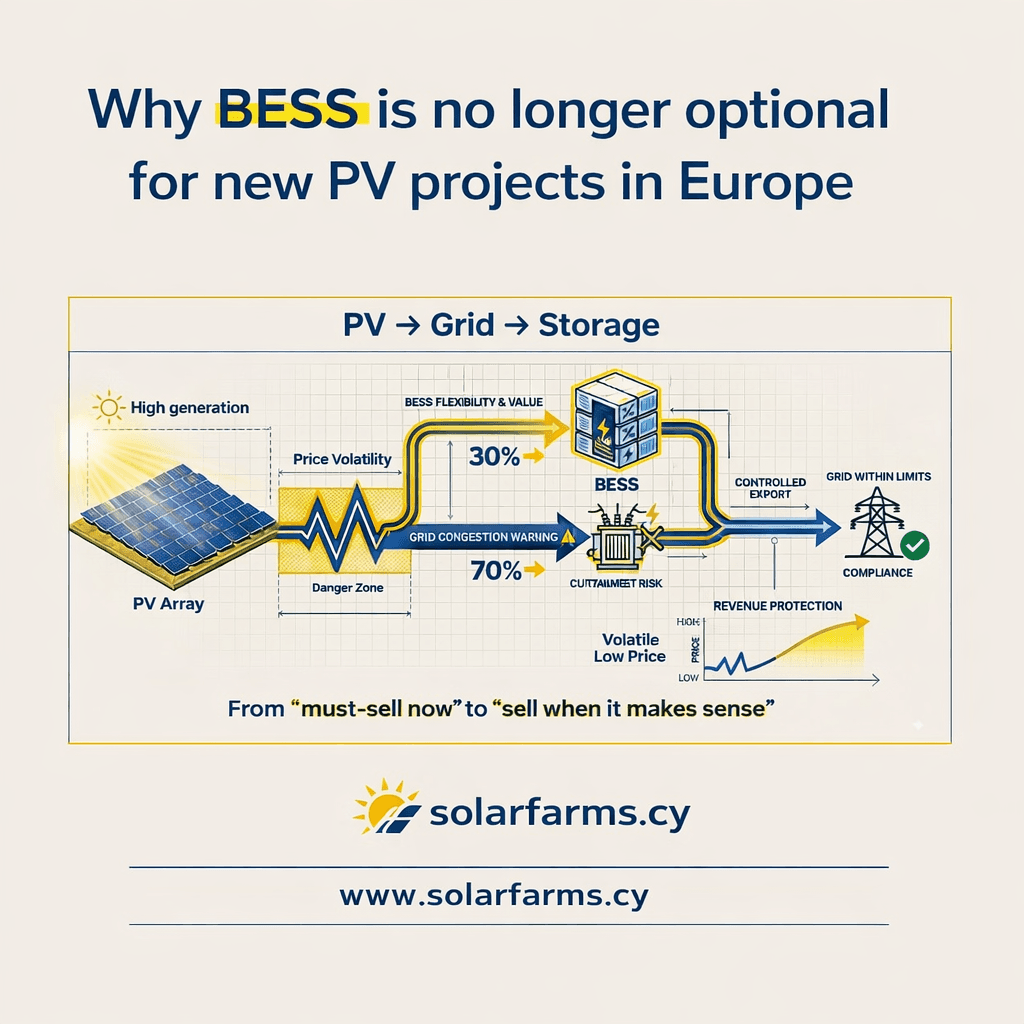
The Uncomfortable Truth About Solar-Only Projects
If you're planning a new renewable energy project in Cyprus today — whether a 1MW commercial rooftop or a 10MW utility-scale park — building without Battery Energy Storage is like buying a car without insurance. The question is no longer “should I add BESS?” but rather“how much BESS do I need?”
Three converging forces have made this shift inevitable: runaway curtailment destroying production, midday price collapse eroding per-MWh revenue, and EU-wide regulatory trends mandating storage integration. Let's examine each with real data.
Curtailment: From Zero to Crisis in Four Years
Cyprus has experienced the most dramatic curtailment escalation in the entire EU. Data from an operational 5.01MW solar park tells the story:
Curtailment Growth: 0% to 47% in 4 Years
Real operational data from a 5.01MW solar park in Cyprus
Energy SoldCurtailed Energy (Wasted)
At a system-wide level, the numbers are staggering. In 2025, approximately 306 GWh of clean solar energy was curtailed — enough to power 51,000 households for an entire year. That represents an 83% increase over 2024's already-alarming 167 GWh.
Why is curtailment so extreme in Cyprus?
Cyprus operates as an isolated grid with zero interconnection to any neighbouring country. Unlike Spain, Germany, or Greece — which can export surplus solar to neighbours — every MWh generated in Cyprus must be consumed on-island or wasted. Meanwhile, the TSO must maintain 210-250 MW of conventional “must-run” thermal generation for grid stability, directly competing with solar during peak production hours.
What Curtailment Actually Costs You: Loss Per MW
The financial impact scales linearly with park size. Here's what solar-only operators are losing annually at current curtailment rates, based on verified 2025 operational data:
1 MW Park
3 MW Park
5 MW Park
10 MW Park
Over 25 years, a 5MW park without BESS loses €22.3 million in unrealised revenue.
And this assumes curtailment stabilises at 47%. With 200+ MW of new solar licensed for 2026-2027, the trend will only worsen without grid-scale storage deployment.
The Midday Price Collapse: When Solar Eats Itself
Even the energy that isn't curtailed faces a brutal economic reality. When every solar park on the island generates at full capacity between 10:00-14:00, electricity prices collapse. Verified data from 339 days of Cyprus Day-Ahead Market (DAM) trading (1 Oct 2025 – 4 Sep 2026) reveals a stark picture:
Cyprus Electricity Price Profile: Midday vs Evening
The implications are devastating for solar-only operators. Your panels produce the most energy precisely when it's worth the least. On some days, midday prices dip to zero or even negative — 5.2% of all half-hour periods in our dataset recorded €0/MWh prices, and 7.3% were at or below €10/MWh.
A BESS changes this equation fundamentally. Instead of being forced to sell at rock-bottom midday prices (or having your production curtailed entirely), you store energy at €0 cost (since it would otherwise be wasted) and discharge during the €212/MWh evening peak. Every MWh shifted from curtailment to evening dispatch nets you ~€183/MWh after accounting for 86.32% AC-AC round-trip efficiency losses.
What Other EU Markets Are Doing — and Why Cyprus Must Follow
Cyprus is not alone in facing solar integration challenges. But while other EU markets have adapted, Cyprus remains critically behind on storage deployment:
| Market | Curtailment Rate | Grid-Scale BESS | Interconnection | BESS Policy |
|---|---|---|---|---|
| Cyprus | 47% | ~0 MW | None (isolated) | Limited — Category B only |
| Germany | 3-5% | 12+ GW deployed | 17 interconnectors | Full market participation |
| Spain | 2-4% | 4.5+ GW deployed | France, Portugal, Morocco | Capacity market + ancillary |
| Italy | 5-8% | 3+ GW deployed | Multiple (FR, AT, CH, SI) | MACSE capacity market |
| Greece | 6-10% | 1.5+ GW pipeline | Italy, Bulgaria, Turkey | Hybrid licensing + storage targets |
| UK | 1-3% | 8+ GW deployed | France, Netherlands, Belgium | Full merchant + CfD |
EU Trends Making BESS Mandatory
- Germany: New PV parks above 1MW now routinely pair with BESS. The market rewards flexibility — arbitrage revenue alone justifies investment.
- Spain: Hybrid PV+BESS auctions launched in 2024. Storage co-location gives priority grid access and better PPAs.
- Italy: MACSE capacity market pays BESS operators €70k-120k/MW/year just for availability — on top of energy revenues.
- UK: 8 GW of grid-scale BESS delivers frequency response + arbitrage. New solar without co-located storage is now the exception.
Why Cyprus Is Uniquely Vulnerable
- Zero interconnection: No cables to export surplus. Every MWh must be used or stored on-island.
- Highest solar irradiation: 1,800 kWh/m²/year means massive midday oversupply vs tiny grid demand.
- No grid-scale BESS: ~0 MW deployed vs 12+ GW in Germany. Cyprus is years behind.
- 76% fossil fuel dependency: Grid carbon intensity is 493 gCO₂/kWh — more than double the EU average of 230.
The direction across Europe is unmistakable: every major EU market is either mandating, incentivising, or economically driving co-located BESS for new solar. Cyprus will follow this trajectory — the only question is whether you invest now at lower BESS prices, or later when it becomes regulatory requirement.
The BESS Business Case: Two Revenue Streams
BESS doesn't just protect against losses — it creates new revenue. For Cyprus RES projects, the business case rests on two pillars:
Revenue Stream 1: Curtailment Recovery
Capture energy that would otherwise be wasted
This is pure profit recovery — you're monetising energy that would otherwise generate zero income.
Revenue Stream 2: Time-of-Day Arbitrage
Sell at evening premium instead of midday discount
Even non-curtailed energy earns 59% more when shifted to evening hours. Future DAM access legislation will unlock additional grid arbitrage.
Payback Period: 2-Hour vs 3-Hour vs 4-Hour Systems
Validated against confirmed client pricing (Feb 2026) and the Lighthief financial model. Reference: 5 MW PV park with tracker (9,488 MWh/yr gross production).
Model parameters: 86.32% RTE (full-system AC-AC) | 90% DoD | Linyang SOH degradation curve | €175/MWh blended discharge | 365-day curtailment analysis
Confirmed BESS Pricing (Feb 2026)
Why Duration Matters: The Overflow Effect
Smaller batteries hit their daily capacity ceiling on high-curtailment days. Energy that overflows the battery is permanently lost to the PV park — it cannot be recovered. Day-by-day analysis of 365 days of operational data reveals significant capture differences between system sizes.
Key insight: A 2-hour system captures 35% less energy than a 4-hour system because daily curtailment averages ~11.8 MWh but ranges from 0 to 40+ MWh. On high-production days (spring/autumn), the smaller battery overflows — that energy is permanently lost. However, because the 2-hour system costs ~40% less, all three systems achieve similar payback periods (4.0–4.3 years).
Payback at 47% Curtailment (2025 Reality)
Revenue scales with energy captured per system | OPEX varies by battery capacity
2-Hour (10 MWh)
3-Hour (15 MWh)
4-Hour (20 MWh)
15-Year Lifetime Returns
Accounts for SOH degradation (85% at Year 5 → 70% at Year 15), escalating warranty costs, and ~3,500–4,400 total cycles
| Metric | 2-Hour (10 MWh) | 3-Hour (15 MWh) | 4-Hour (20 MWh) |
|---|---|---|---|
| 15-yr Gross Revenue | €5.1M | €6.9M | €8.1M |
| Total Cycles (15yr) | ~4,430 | ~4,030 | ~3,560 |
| Cycle Headroom (vs 7,000) | 2,570 remaining | 2,970 remaining | 3,440 remaining |
| Year 15 Net Cash Flow | €263K | €363K | €431K |
Which Duration Should You Choose?
Lowest capital outlay. Fastest payback (4.0 years) but captures only 57% of curtailed energy — 1,839 MWh/yr permanently lost. Best if capital is constrained and you need the smallest possible investment.
Balanced choice. Captures 76% of curtailment with near-identical 4.3-year payback. Covers most of the evening peak (17:00–20:00) and generates 33% more revenue than the 2-hour system.
Maximum revenue and best €/MWh cost. Captures 87% of curtailment, generates 53% more revenue than 2-hour, with the same 4.3-year payback. Full evening peak coverage (17:00–21:00).
The data is clear: all three systems pay back within 4.3 years at current curtailment rates. The 4-hour system captures €199K/yr more revenue than the 2-hour at the same payback period. When DAM arbitrage legislation passes, 4-hour systems gain an additional ~€170K–€280K/year from grid charging — making it the strongest long-term investment by a wide margin.
The Hidden Environmental Cost
When solar energy is curtailed, the grid must burn fossil fuels to meet that same demand later in the day. The environmental cost is staggering:
BESS deployment doesn't just improve your ROI — it directly reduces carbon emissions by displacing evening fossil fuel generation with stored solar energy. Every MWh shifted from daytime curtailment to evening dispatch prevents ~0.49 tonnes of CO₂ from being emitted.
What's Coming: Regulatory Tailwinds
Cyprus is behind but catching up. Several regulatory developments will further strengthen the case for BESS:
DAM Arbitrage Access (Expected)
Upcoming legislation will allow BESS to charge from the grid (not just from co-located solar). This unlocks an additional ~€72/MWh net revenue per charge-discharge cycle from pure grid arbitrage — on top of curtailment recovery.
Grid Services Market
Frequency regulation, voltage support, and spinning reserve markets are being developed. In mature EU markets, these services generate €50-120k/MW/year in additional revenue for BESS operators.
EuroAsia Interconnector
The 2,000 MW submarine cable connecting Cyprus to Greece and Israel will eventually reduce curtailment by enabling exports. But it won't arrive before 2029+ — meaning BESS is the only solution for the next 3-5 years of acute curtailment.
Bottom line: Investing in BESS now means you benefit from curtailment recovery today, and unlock additional revenue streams (grid arbitrage, ancillary services) as the regulatory framework matures. Early movers get the best returns.
The Window to Act Is Now
BESS equipment prices are at historic lows. Curtailment is at historic highs. The spread between midday and evening prices guarantees returns. Every month you wait is revenue permanently lost.
Whether you're developing a new PV project or retrofitting an existing park, we can design the right BESS solution for your specific curtailment profile and revenue targets.
Contact Alexander Papacosta: +357 99 164 158 | office@lighthief.com