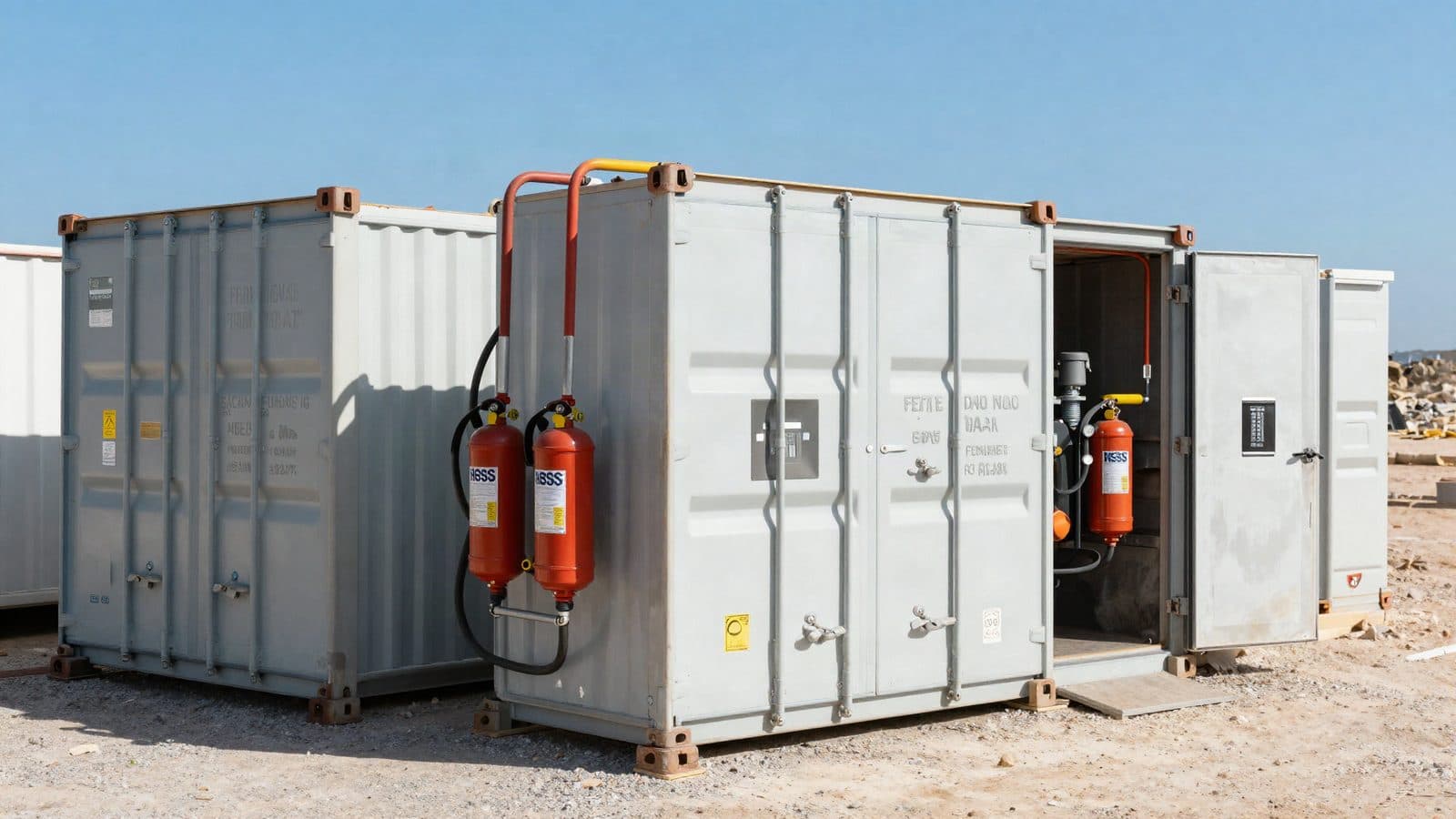
Safety Is Not Optional
BESS safety incidents make headlines. A single thermal event at a battery storage facility draws the kind of media coverage that can stall permitting for an entire region. As developers planning hundreds of containers across our portfolio — totalling hundreds of MWh of lithium iron phosphate storage — safety engineering is not a feature we offer. It is the prerequisite for everything else.
This article covers the specific decisions we made across thermal management, fire suppression, container layout, and BMS design — and the reasoning behind each one. These are not theoretical best practices pulled from a whitepaper. They are the engineering constraints we designed around for a real deployment, in a Mediterranean climate, under commercial insurance requirements, with lender oversight.
If you are evaluating BESS for your solar park, this is the conversation your EPC partner should be having with you. If they are not, that tells you something.
Understanding BESS Fire Risk
Not all battery chemistries carry the same fire risk. Understanding why requires looking at what happens when a lithium-ion cell is pushed beyond its safe operating envelope — a process called thermal runaway.
LFP (Our Choice)
NMC (Higher Risk)
Real-World Incidents
The pattern in reported BESS fires is unambiguous:
- Arizona, USA (2019): NMC battery system explosion injured four firefighters. Thermal runaway cascaded across multiple racks.
- South Korea (2017–2019): 23 separate BESS fire incidents, the vast majority involving NMC chemistry. Triggered a nationwide safety review and temporary moratorium on new installations.
- Liverpool, UK (2020): NMC battery fire at a 20 MW facility burned for several days. Fire service struggled with re-ignition — a hallmark of oxygen-releasing chemistries.
The physics is straightforward: when NMC cells overheat, the cathode decomposes and releases oxygen. Oxygen feeds combustion. The fire can sustain itself even in a sealed container. LFP cells, when pushed past their limits, release phosphate gas — which is not an oxidiser. Without oxygen release, the chain reaction stalls. This does not make LFP fireproof, but it makes the difference between a manageable incident and a catastrophic one.
Thermal Management Systems
Cyprus summers routinely push ambient temperatures above 40°C, with extreme days exceeding 45°C. Battery cells operate optimally between 15°C and 35°C. The gap between ambient and optimal is the engineering problem thermal management exists to solve.
Each of our 40ft BESS containers incorporates a multi-layered thermal management system designed for sustained operation in Mediterranean climates:
Active Liquid Cooling
Liquid-cooled battery racks provide direct thermal contact with cell modules. Liquid cooling achieves 3–5× the heat transfer rate of forced air, maintaining tighter temperature uniformity across cells within each rack.
HVAC Climate Control
Industrial HVAC units maintain internal container temperature between 20–25°C regardless of external conditions. Redundant units ensure cooling continues if one system fails.
Per-Module Temperature Sensors
Thermal sensors on every cell module feed real-time data to the BMS. No blind spots. If one module drifts even 3°C above its neighbours, the BMS flags it immediately.
Automatic Shutdown Triggers
The BMS enforces hard temperature limits. If internal temperature exceeds configurable thresholds, the system reduces power output first, then isolates the affected rack, then shuts down the container entirely.
Container Design for Cyprus Climate
Insulated Walls
Multi-layer insulation reduces solar heat gain. Standard shipping containers are not suitable — purpose-built enclosures with thermal break design are required.
Reflective Coating
External surfaces use high-albedo coatings that reflect solar radiation rather than absorbing it. This alone can reduce internal heat load by 15–20%.
Ventilation Management
Controlled airflow paths prevent hot spots while maintaining fire-rated compartmentalisation. Air intake and exhaust positions are engineered for prevailing wind patterns.
Fire Suppression: Our Approach
Even with LFP chemistry and comprehensive thermal management, a credible fire suppression system is non-negotiable. Insurers require it. Lenders require it. And the physics of lithium-ion storage demands it — regardless of chemistry.
Integrated Aerosol Fire Suppression
Every container in our portfolio is equipped with an integrated aerosol-based fire suppression system. This was not the only option available. Here is why we chose it:
| Technology | Mechanism | Pros | Cons | Our Assessment |
|---|---|---|---|---|
| Aerosol | Disperses potassium-based particles that interrupt the combustion chain reaction | Fast activation, no pressurised vessels, low maintenance, no water damage to electronics | Single-use canisters require replacement after activation | Selected |
| Inert Gas (Novec/FM200) | Displaces oxygen to starve the fire | Clean agent, no residue, proven in data centres | Requires sealed enclosure, heavy pressurised cylinders, higher cost | Considered |
| Water Mist | Fine water droplets cool the fire and displace oxygen | Effective cooling, can be refilled, some re-use capability | Water + high-voltage electronics risk, complex plumbing, freeze risk in some climates | Not Selected |
Automatic Detection
Each container has a multi-sensor detection array:
- Smoke detectors: optical and ionisation types for early-stage detection
- Heat sensors: rate-of-rise and fixed-temperature detection
- Gas sensors: detect off-gassing from cells before visible smoke appears
Two-Stage Response
The suppression protocol follows a deliberate two-stage sequence:
BMS Isolation
The affected rack is electrically isolated. Contactors open, current stops flowing. This removes the electrical energy source before suppression activates.
Suppression Activation
Aerosol canisters deploy automatically once isolation is confirmed. The entire container volume is flooded within seconds.
External Fire Service Access
Suppression systems buy time — they do not replace a fire service response. Every site is designed with fire department access in mind: minimum 4m-wide access roads around the container array, hard-standing turning areas for fire appliances, and clearly marked isolation points. Container spacing (covered below) ensures that fire crews can approach any container from at least two sides.
Container Spacing and Site Design
The physical layout of containers on a solar park site is a fire engineering decision as much as a civil engineering one. Spacing determines whether a thermal event in one container can propagate to its neighbours — and whether emergency responders can intervene effectively.
| Spacing Parameter | Typical Minimum | Rationale |
|---|---|---|
| Side-to-side clearance | 3 m | Limits radiant heat transfer between adjacent containers. Allows personnel access for maintenance and inspection. |
| End-to-end clearance | 6 m | Container doors face the ends. Greater spacing allows emergency egress, ventilation, and fire service approach with hose lines. |
| Fire access road width | 4 m minimum | Must accommodate fire appliances. Hardened surface required — no gravel that impedes vehicle movement. |
| Distance to property boundary | 10–15 m | Prevents fire propagation to neighbouring properties. Local planning authority may impose greater distances. |
| Distance to occupied structures | 15–30 m | Depends on local building code and container capacity. Larger BESS installations require greater setbacks. |
Cyprus-Specific Site Design Considerations
Dry Climate & Brush Fire Risk
Cyprus summers are arid. Vegetation clearance around container pads is mandatory — a 5m firebreak zone of cleared or gravel-covered ground prevents brush fires from reaching the BESS area.
Wind Patterns
Prevailing westerly winds in summer can carry embers and accelerate fire spread. Container orientation and HVAC intake positioning account for dominant wind direction to prevent smoke ingestion.
Dust and Debris
Fine dust from agricultural land and construction sites clogs HVAC filters faster than in temperate climates. Filter inspection and replacement intervals are shorter — quarterly rather than annually.
Total Site Area Impact
Proper spacing increases the total footprint of a BESS installation by 30–40% compared to minimum-code layouts. This is a cost worth paying — it is the difference between an insurable installation and one no underwriter will touch.
Insurance Requirements Drive Design
In our experience, the insurer's requirements are more demanding than the local building code. This is not a complaint — it is the reality of deploying bankable energy storage. If you design to code and your insurer refuses to cover it, you do not have a project.
Here is what our insurance negotiations have taught us about what underwriters actually require:
Fire Suppression Certification
Insurers mandate that the fire suppression system carries third-party certification (e.g., UL, FM, or equivalent). An uncertified system, regardless of its technical merit, will not satisfy underwriting requirements. Our containers are UL 9540A fire-safety tested.
LFP Chemistry Qualification
LFP chemistry typically qualifies for lower premiums than NMC for utility-scale installations. Some insurers now apply surcharges or exclusions for NMC above certain capacities. Our choice of LFP across all parks in our portfolio was validated during the insurance procurement process.
Container Spacing Compliance
Insurer spacing requirements often exceed local building code minimums. Designing to code alone is insufficient — the site layout must satisfy the insurer's fire engineering consultants, who typically require wider clearances, more access roads, and specific turning circle dimensions.
Annual Fire Safety Inspections
Insurance policies mandate annual inspections of all fire safety systems: suppression canisters, detection sensors, BMS alarm logs, and emergency response procedures. These inspections are a condition of continued coverage.
Documentation Package
Underwriters require a comprehensive fire safety plan, emergency response procedures, evidence of operator training, and maintenance logs. This documentation is not optional — it is a condition precedent for policy inception.
The Insurance Reality
Designing a BESS installation without early engagement with insurers is a common and expensive mistake. We involve our insurance broker during the site design phase — not after construction. This front-loaded approach has saved us from costly redesigns and ensures that every park is insurable from day one.
BMS: The First Line of Defence
The Battery Management System is the most underappreciated safety component in a BESS. It is not glamorous. It does not make for impressive site photos. But it is the system that monitors every cell, every second, and intervenes before thermal management or fire suppression ever need to activate.
Our BMS architecture provides seven layers of active monitoring and protection:
Cell-Level Voltage Monitoring
Every individual cell voltage is monitored continuously. Deviation from the expected range triggers an immediate alert. Overvoltage and undervoltage both indicate potential cell failure modes.
Temperature Monitoring Per Module
Temperature sensors on each battery module feed real-time thermal data to the BMS. Thermal gradients between modules are tracked — a sudden differential is an early warning of internal cell failure.
Current Limiting & Overcurrent Protection
The BMS enforces maximum charge and discharge current limits. Overcurrent events — whether from grid faults, inverter malfunctions, or external short circuits — are cut within milliseconds.
SOC Management
State of charge is managed within safe bounds. The BMS prevents overcharging (which generates excess heat and gas) and deep discharging (which accelerates cell degradation and can cause copper dissolution).
Automatic Isolation of Faulty Cells
When a cell or module exhibits abnormal behaviour — voltage drift, temperature spike, impedance change — the BMS isolates the affected string. The rest of the container continues operating.
EMS Communication for System-Level Shutdown
The BMS communicates with the site-level Energy Management System (EMS) via Modbus TCP. If the BMS determines that a container-level issue threatens the broader installation, it can trigger a coordinated shutdown across the entire BESS array.
EN 50549-2 Grid Compliance
The BMS supports fault ride-through as required by EN 50549-2. During grid disturbances (voltage dips, frequency excursions), the system remains connected and responds according to grid code requirements rather than tripping offline and creating additional instability.
Defence in Depth
The BMS, thermal management, fire detection, and suppression systems form concentric layers of protection. The BMS catches problems at the cell level before they become thermal events. The thermal management system maintains safe operating temperatures to prevent the BMS from ever needing to intervene. And the fire suppression system exists as the final backstop — the layer we invest in heavily but hope never to activate.
Putting It All Together
Safety engineering for a utility-scale BESS deployment is not a single system or a single decision. It is the integration of chemistry selection, thermal design, fire suppression, site layout, BMS architecture, and insurance compliance into a coherent whole. Each layer depends on the others.
When someone asks why we chose a particular fire suppression technology, or why our containers are spaced further apart than the minimum code requires, or why we specified liquid cooling in a market where air cooling is cheaper — the answer is always the same. We are building infrastructure that must operate safely for 20 years, survive annual insurance renewals, and protect the investment of the solar park owners who trust us with their sites. Cutting corners on safety is not a cost saving. It is a liability.
Discuss Safety Engineering for Your BESS
Whether you're evaluating fire suppression options, reviewing container layouts, or preparing for an insurance submission, our team can walk you through the safety engineering decisions behind our large-scale LFP deployment — and what they mean for your project.
Contact Alexander Papacosta: +357 99 164 158 | office@lighthief.com