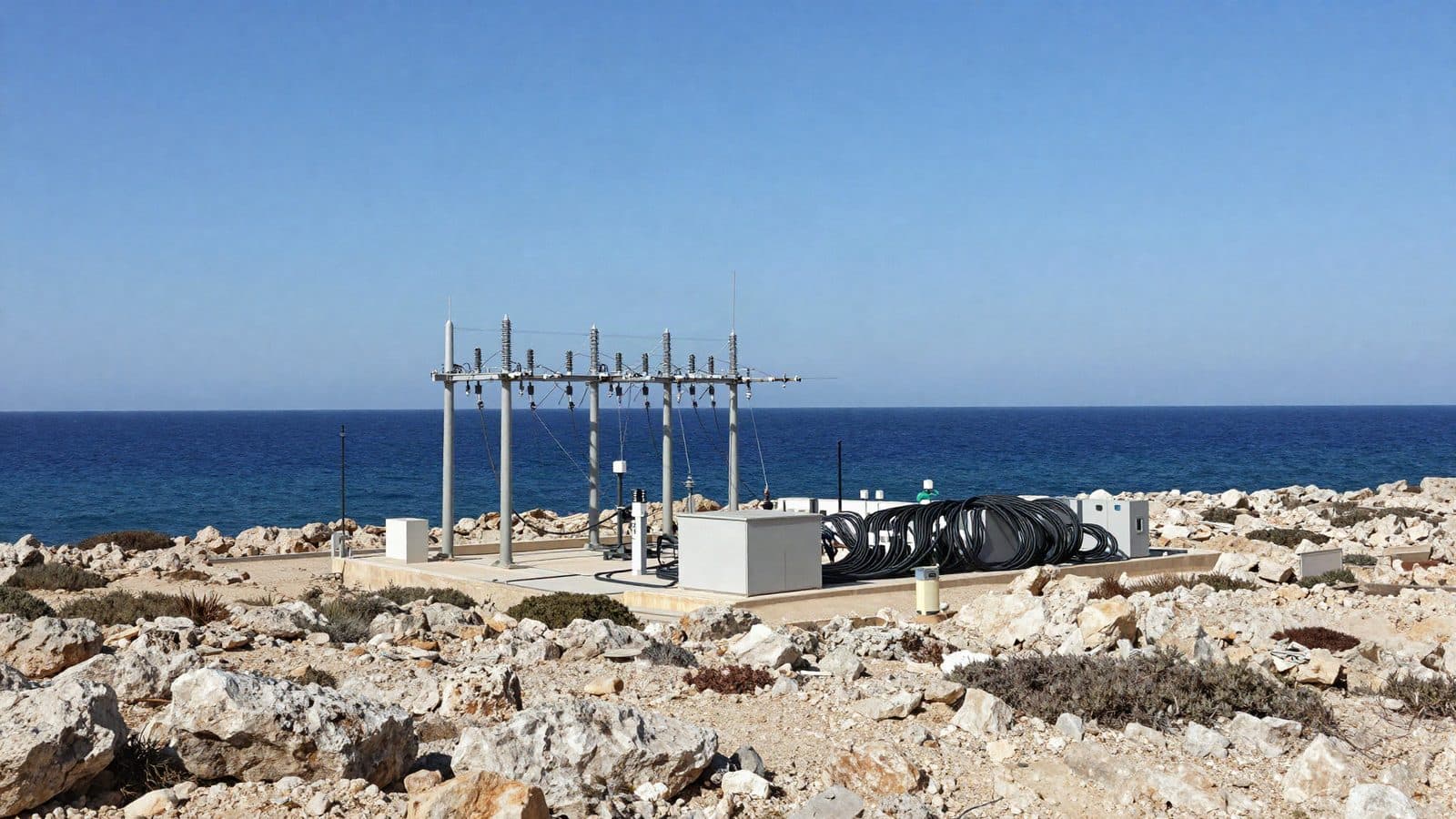
The Cable That Changes Everything
The EuroAsia Interconnector is a 2,000 MW high-voltage direct current (HVDC) submarine cable connecting Cyprus to Crete (Greece) and Israel. At approximately 1,208 km, it will be one of the longest submarine power cables in the world. When operational, it will end Cyprus's status as the EU's only fully electrically isolated member state.
The project has been designated a European Project of Common Interest (PCI) and has received EU funding support. The expected operational date is 2029–2030, though the project has experienced previous delays (the original target was 2025).
Capacity
2,000 MW
Bidirectional power transfer
Cable Length
~1,208 km
Submarine HVDC cable
Connections
3
Cyprus • Crete • Israel
Why It Matters
Today, every MWh of electricity consumed in Cyprus must be generated in Cyprus. There is no import or export capability. When solar production exceeds demand, the grid operator (TSOC) has no choice but to curtail renewable generators — ordering parks to reduce or stop production. The interconnector creates an alternative: export excess solar to Greece or Israel instead of wasting it.
What Interconnection Changes for Solar
The most immediate impact of the EuroAsia Interconnector on Cyprus's solar sector is the reduction of curtailment. Today, approximately 47% of solar production from utility-scale parks is curtailed during peak irradiance hours. This wasted energy represents hundreds of millions of euros in lost revenue across the industry.
With a 2,000 MW export pathway to Greece and Israel, excess solar production can be sold into European wholesale markets instead of being discarded. But the impact on curtailment will not be binary.
What Improves
- Curtailment decreases significantly — excess solar can be exported
- Solar parks earn more revenue from their existing capacity
- Access to European wholesale price levels (potentially higher than domestic)
- Investment climate improves as curtailment risk decreases for new projects
What Doesn't Change
- Curtailment won't drop to zero — cable capacity is finite
- Transmission costs (wheeling charges) apply to exports
- Grid congestion at the Cyprus converter station may limit flows
- Export depends on price differential — sometimes domestic is better
What Interconnection Changes for BESS
For BESS investors, the interconnector doesn't eliminate the investment case — it transforms it. Some revenue streams shrink while others expand, and entirely new opportunities emerge. The net effect depends on timing and market positioning.
Curtailment Recovery — Decreases
As curtailment drops, the volume of free energy available for BESS charging decreases. This is the primary revenue stream today, and it will shrink post-interconnector. However, curtailment won't vanish entirely — cable congestion and transmission costs mean some local curtailment will persist, particularly during peak summer solar hours.
Arbitrage — Expands Significantly
International price spreads between Cyprus, Greece, and Israel create new arbitrage opportunities. When Greek prices spike (winter evenings, cold snaps), Cyprus-based BESS can charge from local solar and discharge into a higher-priced export market. The cross-border spread is likely to be larger and more volatile than the domestic spread alone, creating premium arbitrage windows.
Grid Services — Increases
Cross-border power flows require fast-response balancing assets at both ends of the cable. BESS is uniquely suited for frequency regulation and voltage support at the Cyprus converter station. As the grid transitions from isolated to interconnected operation, the demand for ancillary services increases substantially.
Congestion Management — New Revenue Stream
When the cable reaches capacity, BESS located near the Cyprus converter station can provide congestion relief — absorbing excess power that cannot be exported and releasing it during off-peak cable utilisation periods. This is an entirely new revenue stream that doesn't exist today and emerges only because of the interconnector.
Revenue Impact: Before vs After Interconnector
How the BESS revenue model shifts for a 5 MW / 20 MWh system deployed today.
Before Interconnector (2026–2029)
Revenue driven by curtailment recovery
After Interconnector (2030+)
Revenue shifts to diversified streams
Key Insight
Total BESS revenue may stay stable or increase post-interconnector, even as curtailment revenue decreases. New arbitrage and grid services streams compensate for the curtailment reduction. The revenue model doesn't disappear — it diversifies.
The Early Mover Advantage
Deploying BESS now — before the interconnector becomes operational — creates a compounding advantage that late entrants cannot replicate.
3–4 Years of Maximum Curtailment Revenue
Between now and 2029–2030, curtailment remains at peak levels (~47% average). Every year of BESS operation during this period earns at the highest possible curtailment recovery rate — approximately €400K/year for a 5 MW / 20 MWh system. Investors who deploy in 2026 capture 3–4 years of this premium revenue before the interconnector dilutes it.
CAPEX Recovered Before Revenue Model Shifts
At ~€400K/year curtailment recovery revenue, a 5 MW / 20 MWh system deployed in 2026 recovers a significant portion of its CAPEX by 2029. By the time the interconnector reduces curtailment revenue, the system is already well into its payback period — and the transition to diversified revenue streams (arbitrage, grid services) begins from a position of financial strength.
First-Mover Position in Grid Services Market
When the interconnector creates demand for fast-response grid services at the Cyprus converter station, operators with established BESS installations and proven operational track records will be first in line for service contracts. New entrants entering the market post-2030 will face competition from incumbents with years of performance data.
Operational Track Record When Others Arrive
By 2030, early movers will have 3–4 years of real operational data: degradation curves, revenue performance, maintenance records, and EMS optimisation history. This data is bankable — it supports refinancing, portfolio expansion, and competitive positioning against new entrants who can only offer projections.
The Compounding Effect
Early deployment doesn't just mean earlier revenue — it means better revenue in the pre-interconnector period, lower risk in the transition period (because CAPEX is already recovering), and competitive advantage in the post-interconnector market. Waiting for the interconnector to deploy BESS means missing the highest-revenue window entirely.
Timeline Uncertainty
The EuroAsia Interconnector has faced repeated delays. The original target for completion was 2025, subsequently revised to 2027, and currently expected for 2029–2030. Submarine cable projects of this scale and complexity frequently encounter delays from permitting, procurement, seabed survey complications, and geopolitical factors.
For BESS investors, this uncertainty reinforces the case for immediate deployment rather than waiting.
| Scenario | Interconnector Timeline | BESS Impact |
|---|---|---|
| On Schedule | Operational 2029–2030 | 3–4 years of maximum curtailment revenue, then transition to diversified revenue model |
| Delayed (Likely) | Operational 2031–2033 | 5–7 years of premium curtailment revenue — CAPEX fully recovered before revenue model shifts |
| Significantly Delayed | Operational 2034+ | BESS investment fully amortised under high-curtailment revenue; post-interconnector revenue is pure upside |
The Risk of Waiting
Investors who wait for the interconnector to deploy BESS face a double risk: if the cable arrives on time, they missed 3–4 years of premium curtailment revenue. If the cable is delayed, they missed even more. Either way, the curtailment problem exists right now — every month without BESS is wasted energy and lost revenue.
The Right Approach
Invest based on today's economics — which are compelling on curtailment recovery alone. Treat the interconnector and its associated revenue diversification as upside, not as the base case. If the cable arrives, your revenue model improves. If it doesn't, you're still earning premium returns from curtailment recovery.
Invest in BESS Before the Interconnector
The window for maximum curtailment recovery revenue is open now. Don't wait for a cable that may arrive in 2030 — or later. Deploy BESS today, earn premium returns, and position yourself for the diversified revenue landscape ahead.
Contact Alexander Papacosta: +357 99 164 158 | office@lighthief.com